Showing posts with label x: Monterey Coast Guard Pier. Show all posts

Wednesday, April 2, 2014

Pacific sardine ~ 04/02/14 ~ Coast Guard Pier

(for more information click here and here)

Since I live here and walk Cannery Row on a near daily basis, I feel like I should appreciate the history of Monterey's sardine boom, bust, and return a little more.  But, I don't... that is, until the marina guys offered me as many sardines as I could carry.  Oho!  Uh, two would have been plenty, thanks. They're way bigger than what you get in a can, but really not all that big, coming in at 10" even.  After scaling, beheading, gutting, and attempting to remove backbone and ribs in one fell swoop for 7 sardines, I am now fully aware one of my previous posts of small silvery fish was incorrect.  It was hard for me not to turn a quick fish cleaning into a dissection exercise (Oh, is that the liver? This one must be a girl. What is that!?!  Etc.)  Eh.  At this point without any other sardine cooking practice, I'd say I prefer canned sardines for the 2 times a year I crave them.  Andy was a trooper and patiently picked through the surprisingly tough bones.  Only later did one of the fellas tell me that larger sardines are not considered as good to eat as the smaller ones with softer bones.  Sigh.  Now, I just need to make friends with a crab potter...

ps 01/15/15 - Here's an interesting blog post about historical Cannery Row.

Friday, November 29, 2013

black turnstone and surfbird ~ 11/29/13 ~ Coast Guard Pier

black turnstone (left) and surfbird (right)

The problem with self-study, like I do here on Nature ID, is that it's challenging to catch my own mistakes.  Fellow blogger John Rakestraw's recent post made me do a double-take of his last picture of two birds.  Hmm, the black turnstone and surfbird sure look a lot alike!  Have I been able to tell them apart before?  Based on my only confirmed sighting of surfbirds down in Morro Bay, I remembered them having yellow legs and being significantly heaftier than black turnstones.  Nope, they're only slightly larger.  It just so happened that as we were enjoying a post-holiday walk, we saw the two birds hanging out together along the Coast Guard Pier (apologies for the distance shot, but ever since they put up the fence on the Pier, good close-ups are hard to come by).  I really loved how different they look when they take flight, as Monika Wieland captured so well on her blog Orca Watcher - the black turnstone has the more striking white center strip down its back ending in a bold black spot, and the surfbird has a solid grey back.  As I was looking at my blog records, sure enough my only previous black turnstone post also shows the surfbird.  Right?  I made corrections.

Monday, November 25, 2013

Pacific sea nettle ~ 11/25/13 ~ Coast Guard Pier


The sea nettles have been in great abundance near the shore this past month.  Their sudden appearance seems kind of random, as I've also seen large numbers in the middle of summer.  I wonder if they passively float along with the water currents, or if they actively follow food.  I wouldn't want to be a surfer or a scuba diver, because some days there are so many nettles that I imagine it would be impossible to avoid getting stung, at least on exposed hands.  Being the land lover that I am, I generally don't pay much attention to them, but they are kind of pretty in a brown sort of way. When they die, they turn a ghostly white and tend to sink (didn't get a good picture of this).  I've watched western gulls and opal eye awkwardly try to eat them.  I realized this morning that I hadn't really looked up information yet, and I was interested to see how different aquariums present their online information (sea nettles are apparently relatively easy to keep in captivity): Monterey Bay Aquarium, Aquarium of the Bay in San Francisco, National Aquarium in Baltimore.  I have to say I've been impressed with the improvements MBA has made to their site over the past few years.

Wednesday, September 18, 2013

CA sea hare ~ 09/18/13 ~ Coast Guard Pier


There's a balcony behind the boaters' bathrooms that offers a direct downward view of the water.  It's a spot I like to check during my daily walks.  I often find interesting things there, like night herons. In past years I've only seen a sea slug here or there off in the distance.  Then, about 2 weeks ago, I started spotting a dozen or more sea slugs on the rocks and hanging on for dear life to waving giant kelp (Macrocystis pyrifera). It's wild. What these pictures don't really show is how huge these are! I'd say the light-colored one in the first picture was at least 14 inches long.  Then that clump of sea slugs to the right of it, had an individual that probably exceeded 18 inches long.  No joke.  Notice the one on top of the clump, and how it does indeed resemble a hare?  These sea hares both fascinate me and gross me out, mainly because of their size.  I still haven't quite figured out how they're related to nudibranchs.  In any case, there's some interesting information about them, partly because they're apparently used extensively in research.  Who knew?  In addition to my usual links in the ID above, here are some more, since this is a new animal for me:
Sea Slug Forum (I'm amazed at the stuff I find online.  A sea slug forum.  Really?)
squidoo (I haven't decided if I like this format yet or not.)

ps 09/25/13 - Amazing!  The CA sea hares laid eggs!  Bright yellow masses that appear to cling to the rocks.  I'm hoping to get back there with a camera.

pss 03/06/14 - Here are a couple colorful sea slug blog posts:  Bourbon, Bastards, and Birds. and Catalogue of Organisms.

Thursday, March 29, 2012

floating sea snail ~ 03/29/12 ~ Coast Guard Pier


posted 05/12/12 - It's thanks to Neil's (one who has many online profiles) comment on my previous salps post that I got a lead on the ID of this marine snail. Since it's such a different animal, I've moved it to its own post. And guess what? It eats salps. It was buffet day for this fantastic purple-lipped Carinaria. I had a good time looking for information on this little known animal. Make sure to check out the embedded links above in the ID for informative sites. Very cool. Thanks, Neil!

salps ~ 03/29/12 ~ Coast Guard Pier

salps
Salpa spp.
Family Salpidae

posted 05/07/12 - The strangest creatures get washed into the area between the Monterey Coast Guard Pier/breakwater and the boating gas station near the Monterey Bay Boatworks. I was told by one of the guys on a large fishing vessel that these were jellyfish eggs. I don't know. There seemed to be 3 different types all at least 2-7" in length: round-oblong with reddish-orange circles, chains of smaller ones with the same reddish-orange circles, and a long fin-like creature with purple lips. All seemed to have moving parts that acted like mouths. Like many jellies that get caught in this area, they were only here for one day, maybe in conjunction with the tide. Can you ID?

ps 05/09/12 - Thanks to the generous comments below, I was able to place a general ID on what I originally posted as unknown jelly-like animals. As I looked up information, I added additional photos to show the variety I found. Plus, I'm moving the purple-lipped Carinaria sp. to its own new post. Most online pictures and information were done by scuba divers, so it's possible that salps are unusual to find close to the surface and near the shore, even though they're reportedly quite common in the ocean. There were so many that it wasn't too difficult to take pictures. The hardest part was trying to reduce the glare over the water, so I laid flat on my belly leaning over the docks to snap pictures in the shadows. My best guess is that all the ones shown here belong to the family Salpidae, which is a type of tunicate. To be honest, I don't remember ever hearing of these animals before.

As you can see, not all of them are pointy on both ends, so I do not believe all of them are Salpa fusiformis. There were also one-ended points, chains (clones which become sequential hermaphrodites), round with fringed edges, and large tubulars with wide openings on both ends. Notice each has a small compact round, reddish-orange gut, which apparently helps distinguish Salpa from several other Salpidae, such as Helicosalpa virgula? I had difficulty finding specific information, so I wonder if some of these might be Iasis spp. or Weelia spp. My favorite site for these animals is Dave Wrobel's The JelliesZone. And, yes, salps are chordates, so they're more closely related to us than to jellyfish. Wild! As of 2 weeks ago, salps made the news because there were such massive numbers that they clogged an intake screen at the Diablo Canyon Nuclear Power Plant, which is a couple hundred miles southeast of Monterey near Montaña de Oro.

Sunday, February 12, 2012

sea otter ~ 02/12/12 ~ Coast Guard Pier

southern sea otter
Enhydra lutris nereis

I was really excited to see this sea otter so close to the boat loading ramp near the Coast Guard Pier. I've been keeping an eye out for them, because babies should be appearing anytime now. As usual for around here, this one was tagged on its foot. What was especially fun to see was how it wrapped itself in kelp as it took a snooze. It kept one paw over its nose for the 20 or so minutes I watched it. So cute!

Heavy sigh... Most of my sea otter pictures are crappy little blobs of brown floating in the water. Thanks to Ingrid of The Free Quark, I realized my pride for staying on trails and respecting distance with animals may be deluded at times. I probably got too close to this sea otter (maybe within 15 ft.) to take its picture. There are plenty of incredible photographs of sea otters out there done by people who know what they're doing and with cameras equipped with lenses as long as my arm, so why did I feel the need to take a close picture with my pocket point-and-shoot for my blog? I don't have a good answer. Ingrid also has a very good page on Wildlife Photography Ethics & Philosophy. I find it very easy to point my finger at others and question how they got such a great photograph of an animal, but really I need to look at my own behavior. In some respects, I am still very proud of my crappy photos.

As I was searching for different links for the ID above, I discovered the subspecies Enhydra lutris nereis is listed as "threatened" by the US Fish and Wildlife Service, but the species Enhydra lutris, including the two northern populations, is listed as "endangered" by the IUCN Red List of Threatened Species. Can anyone explain this discrepancy to me?

ps 12/22/15 - I honestly can't recall why I thought the otter pups would show in February.  Maybe I was assuming they're similar in timing to the harbor seal births?  It's likely I may have made an incorrect assumption as to when sea otter pups are birthed.  I've been seeing pups this year since before Thanksgiving at this exact spot near the Coast Guard Pier.  The MBA had one birthed a couple days ago in their tide pool.

Sunday, January 8, 2012

black-crowned night heron ~ 01/08/12 ~ Coast Guard Pier

black-crowned night heron
Nycticorax nycticorax

For quite a while I've wanted to capture a picture of an adult black-crowned night heron during daylight hours. I've seen them regularly near the Coast Guard Pier, adults and juveniles, but I've never had a camera on me when I spot them. It's been almost 3 years ago since we often found a black-crowned night heron while grunion greeting in the middle of the night. We named him "Charlie" and knew if we saw him on the beach, we would have good luck finding grunion. The above picture is an unusual angle, because I was leaning over the railing of recently built restrooms at the boat docks. The actual Coast Guard Pier is once again closed this winter due to additional pier maintenance. They claim it'll be open to the public come February, but I suspect it won't open again until at least June.

Sunday, July 3, 2011

Brandt's cormorants ~ 07/03/11 ~ Coast Guard Pier


With the Coast Guard Pier being closed to the public from mid-February to about 2 weeks ago, the cormorants were able to nest very close to the breakwater fence without being disturbed. This was the first time I've been out to see them this year and captured decent close shots. The big drawback to them being so close is that they stink and there were a ton of flies. Some of the young are indeed bigger than the adults. Interesting to note, the cormorants shared the rocks with about an equal mix of a handful of brown pelicans and a handful of sea lions. I've been loosely watching how these animals seasonally trade places as king of the rocks (click here and here for past posts). Of course, it could have simply been the time of day where the few sea lions remaining were out swimming.

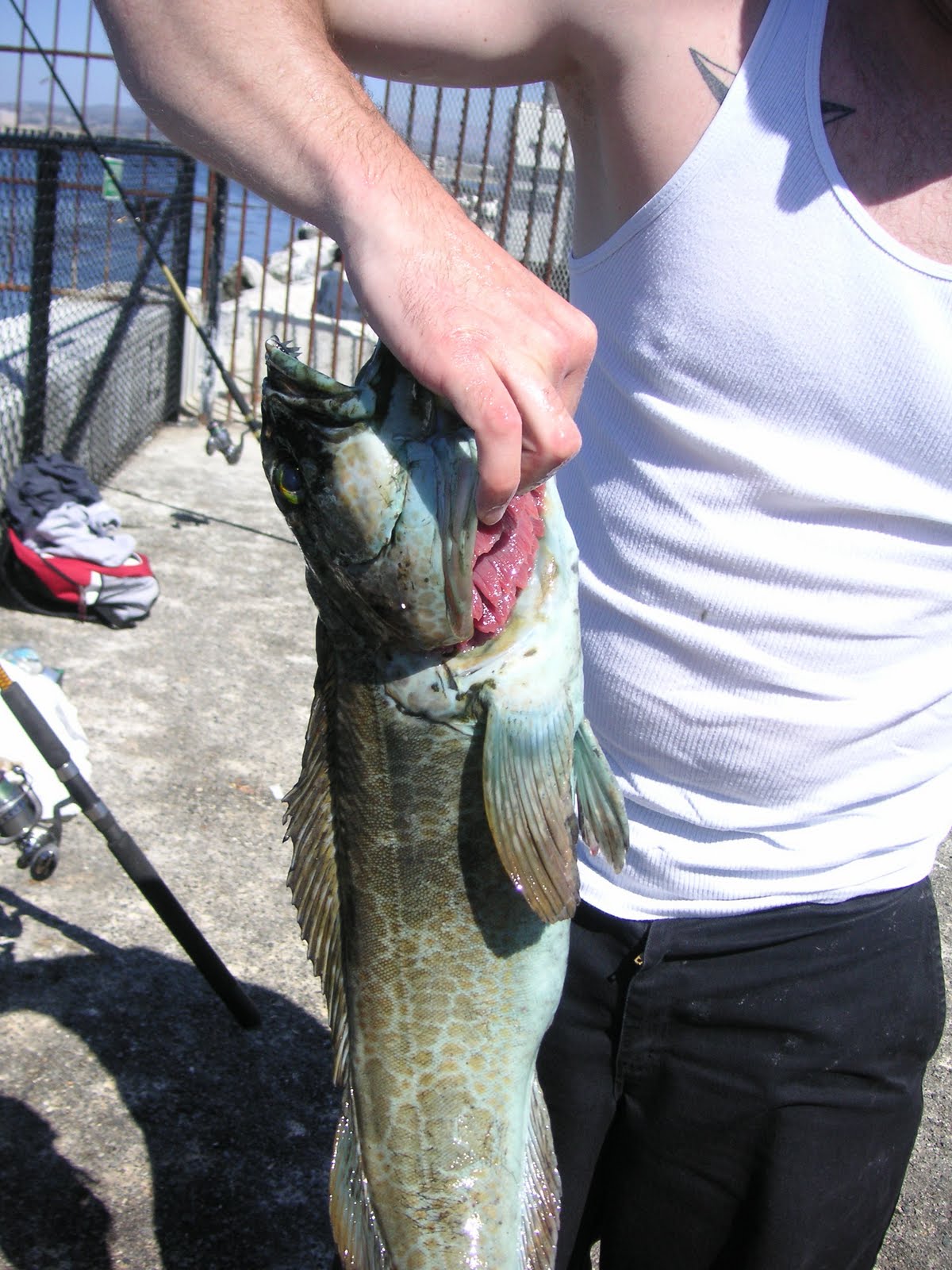
lingcod ~ 07/03/11 ~ Coast Guard Pier


Since I don't scuba dive or fish, the only time I ever really get to see fish up close and personal is in the Monterey Bay Aquarium, the local fish markets, or the buckets of what fishermen catch along the piers. I'm pretty sure of this ID, but I have yet to find a comprehensive fish photo ID site.

Wednesday, January 26, 2011

sea otter ~ 01/26/11 ~ Coast Guard Pier

southern sea otter
Enhydra lutris nereis

I rarely spot sea otters out of the water and am always surprised at how big they are, especially when their fur is dried and fluffed out. More often than not, the locals are tagged on their hind feet. This one was sunning itself at sunrise, but per my usual I didn't have a camera on me during my regular morning walk. I came back later to take this picture. It's too bad, because I missed some awesome photo opportunities with a massive elephant seal floating in the water next to the boat docks.

So, as I was looking up embedded links to include in this post's ID (see highlighted names right below the picture), I discovered there are 3 subspecies of Enhydra lutris. Who knew? Our local southern sea otter is the smallest of the three and is also listed as federally threatened. I've also backposted 2 other sea otter pics this morning for those who are curious.

ps - For much better pictures than I can ever provide, check out Greg Magee's smugmug southern sea otter pics. We cross paths regularly in the mornings. I've been tempted to ask him to photograph certain birds and marine animals that I spot.

Thursday, June 17, 2010

acorn barnacle ~ 06/17/10 ~ Coast Guard Pier

red-striped acorn barnacle
Balanus pacificus


Amazingly, this is an arthropod. Can you believe? This is a big specimen at 32mm along its base. I admit to bringing it home from the commercial boat loading dock parking lot and am not sure what to do with it now. Is it still alive? I'm tempted to get a bucket of ocean water to see if it'll open up. I'm making a huge guess as to its ID since there's not a lot of online information for barnacle species. Mainly, because of its size, I'm thinking it must be a Megabalanus. I did find a wonderful marine blog from across the pond while searching for the ID: Jessica's Nature Blog.

ps 11/30/13 - I originally posted this as Megabalanus californicus, but the variation of reported sizes, 30 mm to 60 mm, has continued to bother me.  So, I'm going with the smaller locally found Balanus pacificus as listed in The Beachcomber's Guide to Seashore Life of California.  Part of my problem for tracking an ID is that a couple of my favorite sites (like Walla Walla University and Washington State University) are too far north to include this pretty barnacle, which reportedly ranges from Chile and Peru to Monterey Bay.

Sunday, June 6, 2010

CA sea lion ~ 06/06/10 ~ Coast Guard Pier


California sea lion
Zalophus californianus

There's nothing like a newborn to make you say "Oh my, how cute!" Mother and pup appeared to be exhausted from the birthing experience. However, she did manage to aggressively attack several males to get them to move off nearby rocks. After a big wave washed the baby into the water, she grabbed it with her mouth and tossed him back into the water on the other side of the rock. It took her a while, but she finally moved her baby up to another, higher rock. She was still bleeding from the birth. After about half an hour, the newborn was finally able to nurse. Maybe this one will survive longer than 24 hours.

This is the second sea lion birth I've witnessed in the past 2 weeks. Click here to read my ps note from May 24, 2010 of my first sighting. For those that may not know, sea lion birthing in Monterey is extremely unusual. Usually, sea lions have their pups further south. For a local news video, check out KTVU's recent coverage.

ps 06/07/10 - I have dozens of other photos, but the amount of blood was off-putting even for me. I again heard back from the Marine Mammal Center after asking if they wanted to know this kind of information and how to report dead sea lion bodies. Due to the number of pups that have been born here this year, NOAA has deemed this area a temporary rookery, making it a protected place for mom and pup sea lions. Interesting.

pss 06/14/10 - By Saturday (06/12/10), we noticed most of the sea lions had moved off the rocks along the Rec Trail in Monterey and were crowded onto a small, sandy beach next to the Fisherman's Wharf. Only the weekend before (the date of the photos above), we saw the sea lions covering every rock surface available and were not on the beach - it makes me wonder if anyone from the wharf was deterring the sea lions from establishing themselves on the small spot of sand. By Sunday (06/13/10), sure enough, there were posted signs that sea lions are a federally protected species and to keep a safe distance. Today (Monday), I noticed a significant decrease in the number of sea lions from the Coast Guard Pier to Fisherman's Wharf. I wonder if they've started heading out to wherever they go this time of year. Contrary to what I said previously, I think the total number of sea lions in the area exceeded those of last year.  For additional photos, photographer and friend Greg Magee also captured a mother tossing her baby a couple weeks earlier on May 26, 2010.

Wednesday, May 5, 2010

Brandt's cormorant ~ 05/05/10 ~ Coast Guard Pier


cormorants, sea lions, and brown pelicans

It seems to be in transition as the cormorants and sea lions negotiate space for the coveted breakwater rocks.

Yep, I'm bushed and don't feel like repeating myself from previous posts. Click below in the labels for the developing story. These pics are worth posting for what they show.

CA sea lion ~ 05/05/10 ~ Coast Guard Pier


California sea lion
Zalophus californianus

The literal translation of the scientific name is "Californian big head" for the obvious feature of mature males. Haha! I kid you not. The last time I posted about sea lions, I wondered if the larger individuals might be Stellar sea lions (Eumetopias jubatus). Nope. I take that back after finding more information. I'm sure both small and large sea lions are Californian in the pictures above.

Large groups of young males have already arrived in Monterey. It seems kind of early. Last year we didn't see them until the end of May. I would have taken a picture of the masses, but I was close to retching from the horrid smell. There doesn't seem to be quite as many this year, but they still cover every available surface for sleeping. I wonder if the timing of their arrival has something to do with the squid in the area.

Sea lions are interesting to watch. You see them peacefully sleeping and think, awww, how cute... until one invades the space of another and a loud fight ensues. They're not my favorite animals in the world, but it's been good to learn about them.

ps 05/24/10 - During my typical early morning walk to the Coast Guard Pier, I encountered a scene that can best be described as extremely disturbing on so many levels. At the boat loading dock, I noticed a familiar photographer with a tripod, who was way too close to a newborn sea lion. WHAT?! Everything I've found online states we only have males here in Monterey and the birthing happens further south. Apparently this is not true and I've suspected this for some time. Sure enough the female was nearby with blood streaks from the birth all over the loading dock. I stopped to watch next to several temporary warning signs of how it's illegal to get within 50 feet of marine mammals, which were taped to municipal, white and orange plastic parking A-frames. Within a few minutes, a young fellow came out of the local kayak shop with a double-sided oar. He proceeded to whack the small sea lions with the oar. Again, WHAT!?! I hollered out, "What the h*ll are you doing!?!" He stated matter-of-factly that he was authorized and to ask his boss if I had any questions, who happened to promptly pull up in a Monterey City truck. I exchanged some not-so-nice-words with this boss who repeatedly told me (as if the verbatim repetition would somehow make me feel okay about what I had just witnessed) how the City of Monterey has authorization to do whatever it takes to get the sea lions off the boat loading dock... short of killing them, 'cause then that would be illegal. I pointed out that there was no one loading boats at the moment and asked why was it necessary to harass the sea lions in such a manner, especially with an exhausted mother and newborn nearby. It was after this that the young fellow dropped his oar and took up a water hose to move most of the sea lions into the water. I was left dumbfounded and started a conversation with the photographer. I asked him what he does with his photos. He said he e-mails them to researchers at Hopkins Marine Station, but it was his belief no one cared. Both the boss and the photographer had called the marine mammal hotline to report the newborn. I'm still sick over seeing this.

pss 05/25/10 - What? You thought I'd be quiet about this? I heard back from both NOAA and The Marine Mammal Center. Apparently, this is the first year they've had reports of California sea lions giving birth in the area. The pups generally die within a day. They're not sure why this is happening. I also received a link to NOAA's current policy on nuisance animals. Hmm...

pss 06/06/10 - Instead of water spray (or oars), they're now using an electrical wire on the boat ramp to keep the sea lions off. I wouldn't mind so much if the fellow doing it, previously with an oar, didn't appear so gleeful when he turns on the electricity to watch all the sea lions jump off as quickly as possible with some looking like they injure themselves falling over wooden barricades. I have pictures of a mother and her newborn here.

pss 06/27/10 - I don't know if my complaint had anything to do with it, but the fellow formerly of the oar has been replaced by some very defensive city workers who now only appear to use water from a hose to move sea lions.

Friday, April 9, 2010

cormorants and sea lions

Simply a post to show that the cormorants aren't always on the rocks. Often during the day, they go off to feed or simply don't seem to be around. Yet, the sea lions don't move in to the empty space this time of year.
eared grebe
Podiceps nigricollis

For a moment, I thought this might be a horned grebe (Podiceps auritus). I find the seasonal changes of plumage to be challenging for IDs, especially since I know so little about birds in general. Based on Cornell's Lab of Ornithology (linked in the scientific names above), this eared grebe may likely be in the process of changing into its breeding plumage and the horned grebe is only in our area in its winter black and white form. I'm left with a question: what constitutes summer or winter, when we have "summer" flowers blooming here in late winter/early spring?

As side notes - I have trouble IDing grebes in particular. In fact, before researching last year's May 10, 2009 grunion greeting post, I never heard of a grebe before. I've found Cornell's site to be my favorite resource for bird IDs. Plus, they were very kind in replying to my query about rights to linking to their site.

ps 05/20/10 - I'm amused even experienced birders get these mixed up. Don Roberson spells out the differences between eared and horned grebes on his creagus site.

Wednesday, February 24, 2010

California sea lion
Zalophus californianus

Sea lions are so much cuter when they're smaller. Sigh, yes, my parents took us to SeaWorld San Diego as kids and to this day I still view sea lions as trainable circus curiosities with beach balls on their noses, something like (gag!) dancing elephants, women with beards, or Siamese twins, hence my general disinterest in these animals.

Thanks to this creagus site, I just learned the larger sea lions I often see along the Coast Guard Pier may be Steller sea lions (Eumetopias jubatus)... and here I thought they were simply older and grumpier versions of the smaller boys. Additionally, I've always thought we had sea lions in Monterey year round, and some years, like last year towards the end of May, the local population explodes. I can usually smell the extra sea lions well before I hear or see them.

I should look into learning more about our local sea lions, particularly in regard to seasonal fluctuations considering several reputable online sites claim both species are mainly in Monterey during the fall and winter, with some in the spring and summer. I have found the opposite is true. I have photo evidence that large groups are here at the end of May and well into the summer, so I beg to differ with the experts. Hmm?

bat star ~ 02/24/10 ~ Coast Guard Pier

bat star
Patiria miniata

It's always fun to see a brightly colored sea star.

Maybe it shows my age, but I still want to call it a starfish. I wrote my first term paper in the 5th grade on starfish, "Echinoderms: Eating Out." I liked the big fancy name echinoderm and, admittedly, largely copied my paper verbatim out of our home set of the World Book Encyclopedia - apologies, Mrs. Wilson!

A friend of mine, who volunteers at the Monterey Bay Aquarium, tells me Asteroidea are not fish and in order to avoid confusion for children, the MBA would prefer for the public to call them sea stars. I point out that they're not stars, either. The starfish/sea star argument has become a bit of a running joke between us.

Come on! Starfish is one word right? If one follows the protocol of common names that entomologists use, then it's obvious it's not a true fish. For example, a dragonfly (Odonata) is not a true fly, but a house fly (Diptera) is. Do you see the difference? I'm not sure where I picked up this tidbit of info, but here's how I understand it: when it's two words, then the last noun accurately describes the thing in question; when it's one word, then it is not the thing stated. Does this make sense? Here are other examples of one-word nots: butterfly (Lepidoptera, not Diptera), ladybug (Coleoptera, not Hemiptera), caddisfly (Trichoptera, not Diptera), sawfly (Hymenoptera, not Diptera), mealybug (Homoptera, not Hemiptera). I maintain starfish is a perfectly acceptable common name. Phew! I'm done with my rant for the day.

ps 11/02/10 - For a better written post on this same topic (not starfish), see Bug Girl's post.

pss 03/14/12 - For whatever reason it's validating to see other bloggers blog about this same issue. See Jim Johnson of Northwest Dragonflier for another better written explanation.