Showing posts with label * collected. Show all posts

Wednesday, April 2, 2014

Pacific sardine ~ 04/02/14 ~ Coast Guard Pier

(for more information click here and here)

Since I live here and walk Cannery Row on a near daily basis, I feel like I should appreciate the history of Monterey's sardine boom, bust, and return a little more.  But, I don't... that is, until the marina guys offered me as many sardines as I could carry.  Oho!  Uh, two would have been plenty, thanks. They're way bigger than what you get in a can, but really not all that big, coming in at 10" even.  After scaling, beheading, gutting, and attempting to remove backbone and ribs in one fell swoop for 7 sardines, I am now fully aware one of my previous posts of small silvery fish was incorrect.  It was hard for me not to turn a quick fish cleaning into a dissection exercise (Oh, is that the liver? This one must be a girl. What is that!?!  Etc.)  Eh.  At this point without any other sardine cooking practice, I'd say I prefer canned sardines for the 2 times a year I crave them.  Andy was a trooper and patiently picked through the surprisingly tough bones.  Only later did one of the fellas tell me that larger sardines are not considered as good to eat as the smaller ones with softer bones.  Sigh.  Now, I just need to make friends with a crab potter...

ps 01/15/15 - Here's an interesting blog post about historical Cannery Row.

Wednesday, March 19, 2014

Annaphila decia ~ 03/19/14 ~ Pinnacles


More dead animals.  Hey, don't laugh at my photos, okay?  I should have asked for better lighting; the busy office was incredibly dark.  Getting decent pics is a crapshoot for me, as is evidenced by my crappy photos label.  I have zero interest in photography itself.  However, looking at my photo set compared to the standard is making me feel a bit embarrassed that I didn't take the time to line them up perfectly, properly sized, lighted, etc.  Eh, as it was, it took me a good 2-hour visit to take photos of a few trays' worth of Paul Johnson's Annaphila specimens, some from the Pinnacles National Park collection and some from his personal collection.  Thank you for your time and attention, Paul!

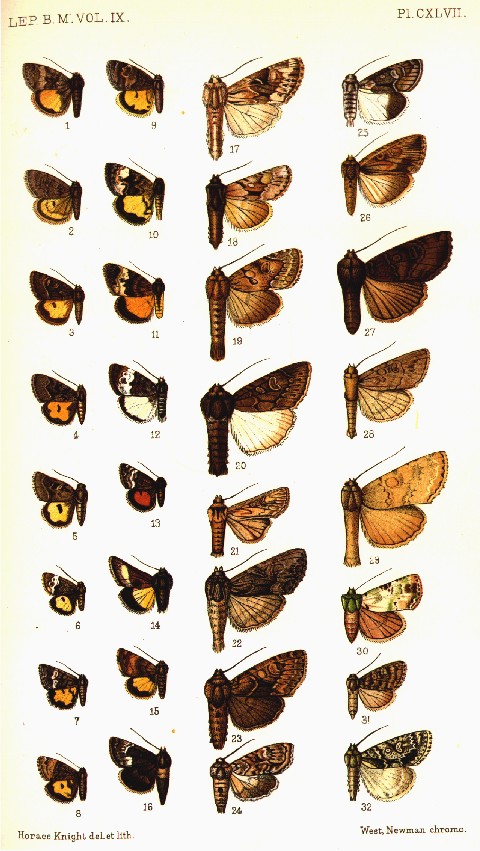
While I prefer alive and natural, over dead and spread, collections do have their uses.  My photos of a live Annaphila from March 9, 2014 match Paul's 4 A. decia specimens, especially compared to the series (scroll down for Annaphila spp.).  There's a distinctive, cartoony sideview of a boy's face on the hindwing, too.  The collection dates were 03/12/02, 03/18/07, and 2x 04/13/06 (yes, yes, I use mm/dd/yy).  That's good enough for me, even though I still don't think they're well represented online and barely match old hand-drawn plates (Hampson Species Index, figs. 7 & 8).  I did find it interesting that a couple more photos were uploaded to BugGuide in the days since my live post.  It's natural, since they're on the wing now.  And, I also located this gorgeous live shot, despite its misspelling (a challenge of online searching).

Alright, I'll admit I was jumping the gun the other day, fantasizing about how I may have accidentally found a previously undescribed species.  It's funny; I'm not ashamed.  Regardless, it reminded me of an item on my bucket list.  I'm not ready to go down that path now, anyways. Someday, right?  

Annaphila decia head on view

I should mention, it's really difficult to spread tiny moths this well.  Spreading takes good dexterity, talent, patience, and desire.  I have none of those qualities.  It's cool how those upright scales (that looked like jumping spider eyes) are still preserved in the spread body.  Now, all I need to do is find me some jumping spiders...

ps 03/27/14 - I am still researching this and may end up personally comparing with U.C. Berkeley's Essig Museum of Entomology original paratypes, which are accurately identified.  There is a potential that my photos, Paul's specimens, BugGuide, and Flickr are all the same, just not A. decia. Crazy, huh?  Go museums!

Friday, February 21, 2014

western blacklegged tick ~ 02/21/14 ~ Hatton Canyon

female western blacklegged tick (lookalike in eastern US - deer tick)
Ixodes pacificus (lookalike in eastern US - Ixodes scapularis)

posted 02/27/14 - I remember hearing adult female blacklegged ticks are about the size of a sesame seed, so I thought I'd compare.  Yep.  It's 2 or 3 mm long, depending on if you include the relatively massive mouth parts.

She is my souvenir from Hatton Canyon.  Within 4 hours after strolling through the canyon, my left side began to feel really sore, as if I just had a vaccine shot that gives a strong punch.  I've been generally achy all over anyways due to lingering bike accident injuries, so I kind of brushed it off.  But it kept hurting more and more, so I took a look in the mirror.  Heey, I don't have a mole in that location.  What is that?  Ooof, a tick!  

My immediate reaction was to pull it off immediately.  I think you're supposed to be careful in how you do it, so as not to break off mouth parts or inadvertently squeeze any potential bacteria into the bite wound.  Eh, that's not my instinct.  Get it out, now!  I broke a couple of her legs in the process, as you can see in the picture.  It amazes me how they can get their mouth parts so far into the skin.

I've only ever been bitten by a tick twice before (that I know of), once on my eyelash line while camping on a friend's farm in southern Ohio (I thought the shadow in my view was a crusty chunk of sleep), and another in my butt crack from a day trip to Rocky Creek (it felt like a wedgie). Neither of those bites hurt at all.  So, I was really surprised at what a punch this one gave me for a little more than 24 hours after tick removal.  I kept saying, "I can't believe how much it hurts."  Thankfully, it doesn't hurt at all now.

I'm generally pretty diligent in doing tick checks, which can also be fun with a partner. Who knew "tick check, tick check" could be a bedroom call?  Eh-hem.  But this time, it didn't occur to me I had been on a "hike", so I didn't check, even though Hatton Canyon habitat matches tick territory to a T.  Doh!

bite site on torso 24 hours after removal of tick

No, that's not my boob.  Had to use a flashlight to get a clear shot of the bite site.  It's exactly the diameter of a pencil eraser.  I'm watching it for infection or a bull's-eye ring. Although, the hypochondriac in me is convinced I'm developing symptoms of anaplasmosis.  I have been feeling less than spectacular this week.

There are a surprising number of tick sites online, and who knows how reliable most of the chat community compiled information is anyways.  Lyme disease gets a lot of publicity, but it's not the only tickborne disease.  In addition to my standard links in the ID above, I want to call out a few reputable sites by name (click around, they did an excellent job!):

And lastly, for a parasite souvenir to beat them all, check out fellow blogger Camera Trapping Campus' bot flies from Belize.

ps 03/08/14 - TickEncounter contacted me fairly quickly confirming my ID and asking what type of seed was in the picture I submitted via their online form.  I replied with a link to here.  Whoa!  Whoever is writing me sure has a lot of character.  S/he is incredibly interested in Garrapata State Park, which means "tick" in Spanish.  I gave them local CNPS and FOG contact information, folks I figured would be most familiar with Garrapata's ticks.  They also asked me if they could adapt my blog post for TickEncounter.  Sure.

With their permission and edit (which I found curious), here's what they said, "Thanks Katie for the backstory. One of those other tick bites must have been a western blacklegged tick, too. That earlier bite "primed" you to react like you did.  Our studies suggest strongly that a certain protein or proteins in the tick saliva stimulate an IgE response. On re-exposure, the antigen-bound IgE also binds to basophils through their Fc receptors, activating the basophils to release their "payload" of histamine and other cytokines--resulting in the immediate type hypersensitivity rxn that your body so aptly displayed.  Itching from a tick bite might seem annoying but hey, if it helps alert you to the tick so you can promptly remove it then maybe its a good thing." 

Well, I have to say I wouldn't call the pain I felt with my bite as "itching".  In any case...  Doh!  A classic Jones-Mote levels of hypersensitivity!  That's why I didn't have a reaction from the first bites of 2 different species of tick, my body hadn't made antigens yet.  It's interesting that my initial lack of reactions look like they're specific to the type of tick (Ohio does not have I. pacificus).  I barely remember this from my Medical Entomology class (I think professionals use another reaction model now besides Jones-Mote), but the first time someone gets bitten by certain insects and related, they will not have a reaction.  None.  I'm serious.  Hence why I think so many diagnosed with Lyme disease never even knew they had been bitten by a tick.  Given enough time (~2 weeks?) for the body to create antigens, there will be an immediate reaction upon the 2nd bite.  More bites?  Then a delayed reaction after a day or more.  Eventually if bitten, like constantly, the body will go back to not having a reaction at all.  Crazy, huh?  (Disclaimer: I could totally be recalling this incorrectly, but I can't find anything online that isn't bogged down in immunoglobulin gobbledygook.)

Wednesday, October 9, 2013

salt bush ~ 10/09/13 ~ Elkhorn Slough

 salt bush/fat-hen among pickleweed

When fellow bloggers post seasonal pictures from their neck of the woods, like the common milkweed, I'm reminded of how much I absolutely loved autumn in Ohio - the vibrant colors, the damp woodsy smell, the crisp chill in the air.  Sigh.  It's taken me a while to appreciate autumn here on the coast of CA.  I tend to seek out places, like Garzas Creek, that remind me of Ohio.  Amazingly, autumn colors occur in the slough, too, where salt water meets fresh water.


I try to take full advantage of nature center displays and will often take pictures before a hike as a take-along ID guide.  I love it when they have sample plants with identification tags... that is until what they show cannot be confirmed anywhere else.  Erg.  Assigning names for this post was a bit of a challenge since there have been recent changes among different classification systems.  Same or different species?  Who knows? Other names associated with this particular salt bush are:  A. triangularis ssp. hastata (as shown above), spearscale, A. patula ssp. hastata.  Even fat-hen refers to different kinds of plants.  Then, there's the question of is it native (as shown above) or naturalized?  Other names associated with local pickleweed are:  Pacific swampfire, S. virginica, glasswort, S. depressa.  And finally, Jepson, our CA plant bible, sticks with Chenopodiaceae as the family name.  Phew.

Sunday, April 22, 2012

vernal pool bent grass ~ 04/22/12 ~ MBC CNPS Wildflower Show

Agrostis lacuna-vernalis
Poaceae

Normally, I never include pictures from the annual Monterey Bay Chapter of the California Native Plant Society Wildflower Show held at the Pacific Grove Museum of Natural History. However, for the 51st Wildflower Show (the largest in the Northern and Western Hemispheres!) there was a newly described grass species found at Fort Ord. When Brian LeNeve and his wife Carol were creating the identifier card, they faced a challenge coming up with a common name. Before they added water to this tiny chunk of specimen, the grass was actually bent... hence the name. Despite the lack of rain this year, there were over 670 species of flowering plants at the Wildflower Show - not too shabby.

I love Fort Ord and am looking forward to when 15,000 acres are saved as publicly accessible natural areas. The species diversity there is incredibly unique. Speaking of which, the federally-owned former Fort Ord lands (~14,600 acres) has just become the newest National Monument (link to another local news article) putting it on the map with the likes of Pinnacles National Monument. The remaining few hundred natural area acres belong to the State of CA as Fort Ord Dunes State Park.

ps 05/11/12 - I've since learned Brian was pulling our legs during his talk the day before this picture was taken. For those who don't know the genus Agrostis is known as bent grass. From David Styer I guess there was some talk about whether it should be vernalis-lacuna or lacuna-vernalis.

Friday, April 1, 2011

unidentified caterpillar ~ 04/01/11 ~ at home


unidentified woollybear caterpillar
possible Hypercombe, Grammia, or Spilosoma sp.

I collected this one 03/31/11 down in the Carmel Highlands. Coincidentally I saw several others in La Selva Beach in Santa Cruz County on 04/02/11. I've hesitated posting these pics for several reasons, the least of which is I don't know what it is. Indeed, there are many species of all black, fuzzy, tiger moth caterpillars. The term "woollybear" can be generically applied to any fuzzy caterpillar in the Arctiini tribe. I suspect the most recognizable tiger moth caterpillar is the banded woollybear (Pyrrharctia isabella), which is more common in the eastern U.S. but can occasionally be found in CA. What I have is NOT an Isabella tiger moth.

The best way to identify an unknown caterpillar is to raise one and identify the adult. The challenge with this is figuring out what it eats, being patient enough to let it rest and pupate, and having the luck that it doesn't die in the process. I initially tried to feed it oak leaves, but this one didn't seem interested. I offered it some radish tops and it chomped away for a couple days. Then a week ago (I'm posting 04/09/11), I found it curled up on top of the soil in the container. Had it not been curled up I would have thought it was getting ready to pupate. I figured it must have died and was quite sad. By the next morning, it had climbed up the oak twigs. Since then, it's done this several times without eating any more, despite my throwing in a veritable salad of radish tops, lettuce, and dandelion shoots. It's been stormy off and on this past week, so I wonder if this playing dead and climbing is a natural behavior and/or related to the weather.

Finally, in an all black fuzzy caterpillar, I wanted to take a picture of the most distinguishable feature. In the first picture above, those 10 red things are prolegs. Without getting into too much repetition of what can easily be found elsewhere online or in books, lepidopteran larvae have 6 jointed legs and up to 10 prolegs. Caterpillar lookalikes have differing number of prolegs: some beetle larvae have 6 jointed legs and no prolegs; and sawflies (not flies, but wasps) have 6 jointed legs and 12 to 16 prolegs.

Wednesday, July 14, 2010

Edwards' glassy-wing moth ~ 07/14/10 ~ at home


I found this moth in the stairwell early Monday morning. What struck me about this particular moth was that it was much bigger than most I usually see around here. Plus, it appeared as if the scales on its wings had been rubbed off. I figured it was on its last legs of life, so I uncharacteristically collected it, put it into a small rubbermaid, and then placed it in the fridge next to the mayo and salsa with hopes to test run taking a couple pictures through my dissecting scope later in the day... yeah, I know, for several months I've been threatening to pull out the ol' Wild M5 and Dolan-Jenner 181-1 Fiber-Lite that I inherited from Sonja. My excuse is the equipment is packed tightly in the closet and I'm generally lazy about pulling things out of storage.

In any case, I've been busy, so I didn't take this poor moth out of the fridge until Wednesday. evening. I tried to provide some water thinking it'd be thirsty after a couple days in the chiller. It looked like it had labial palps, but I couldn't find a proboscis. Oh well. It excreted small amounts of cloudy yellow liquid. I took over 70 crappy photos, because this moth warmed up quicker than I anticipated and was very active.

I hesitated to post considering I thought this moth would be difficult to identify with what I believed to be missing scales. WRONG. Due to its beautiful pink coloring and bulk, I correctly figured it was an arctiid (a recently reclassified group of moths that have always reminded me of L'Oréal eye shadow for their intense colors). I started my internet search for an ID thinking it must be related to the infamous Isabella tiger moth, better known as the woolly bear caterpillar. Amazingly, it wasn't too difficult to find a match. Edwards' glassy-wing moth wings are supposed to be mostly without scales. Powell states it is indeed unusual and one of CA's largest tiger moths. Another local PG resident also found a similar moth last week - note the abdomen is distinctly different than this one. The USGS link in the scientific name above (Pseudo- seems to be a new naming addition) states it flies in September. Maybe we're far enough south that we see them in July?

Uh, I should add... after taking its picture on black construction paper, I moved it outside to my "dormant" ficus for a natural pose - mainly because I worried if it warmed up enough to fly, I'd be chasing a moth around the house. This was another mistake. As I stepped inside to set my camera down, I turned around to see one of my friendly scrub-jays had quickly scooped up this moth. I shouted, "No!!!" Too late. The happy jay flew to a nearby oak tree and proceeded to enjoy its plump morsel.

ps 08/03/10 - I'm happy to report this blog post has been included in The Moth and Me #13 blog carnival, hosted at Today in NJ Birding History by Jennifer W. Hanson.