Saturday, December 7, 2013

ferns ~ 12/07/13 ~ Fort Ord

western bracken fern (and possibly coastal wood fern)
Pteridium aquilinum var. pubescens (and possibly Dryopteris arguta)
Dennstaedtiaceae (and possibly Dryopteridaceae)

Look how prolific the ferns were this year.  Oh my!  I haven't been out to Fort Ord since May, so this was a little bit of a surprise to me.  While I'm normally not a big fan of brown, I appreciated the subtle variation of shades from copper to rusty chocolate. Doh!  When I took these pictures, I had assumed they were all western bracken fern. However, as I was checking information, I discovered there's a similar looking coastal wood fern also reported at Fort Ord.  Even if I had gotten decent close-ups, I'm not sure I'd be able to tell them apart.  I generally try to avoid fern IDs, but they were impossible to ignore this time.

coast live oak ~ 12/07/13 ~ Fort Ord

Fagaceae

As we were driving out to the Creekside entrance on Hwy 68, I noticed most of the oaks had dead tips.  Speeding past, it looked like a deep green mosaic with scattered bits of tan.  I don't think this is sudden oak death, which is caused by a fungus-like pathogen.  I'm guessing it's caused by true fungal diseases, some of which apparently show themselves more when the oaks are drought-stressed, like this year.  I'm not quite sure how that works since fungi generally like moisture.  Right?  This looks very different from the swaths of entirely dead trees I saw last year at Toro Park, which is located right across the street of Hwy 68.  The U.S. Forest Service Pacific Southwest Research Station has an excellent technical report "A Field Guide to Insects and Diseases of California Oaks".  Maybe it's Diplodia quercina branch canker (pp. 88-89) or Cryptocline cinerescens twig blight (pp. 76-79)?  I really don't know.  I'm no tree doctor.  Half the time I can't even distinguish coast live oak from other Quercus spp.  In any case, this widespread dieback is interesting to note.

ps 03/12/14 - An intern from a local paper The Californian contacted me regarding this post.  She wants to use my pictures and information in an article she's writing.  This is the first time I've ever been contacted by a newspaper for Nature ID, so it was an interesting experience... I think for the both of us.  She was sweet but sounded a little nervous.  I gave my photos free of charge, because I didn't want the hassle of creating an invoice and dinging for payment (so many places conveniently "forget" to actually pay).  I'll link to the article once it comes out.  Cool beans.

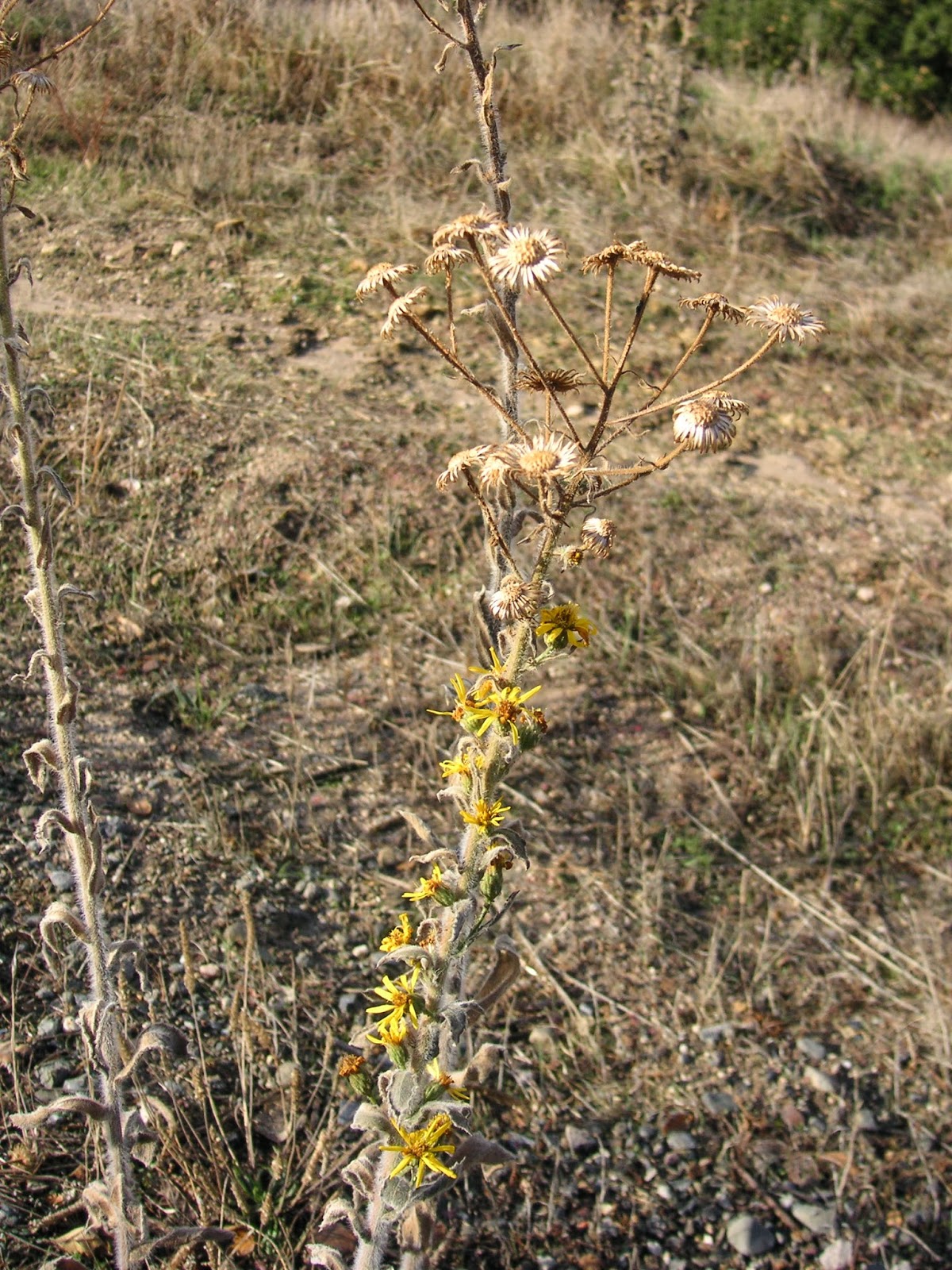
telegraph weed ~ 12/07/13 ~ Fort Ord


Wikipedia says this is a roadside weed.  No kidding.  In my tradition of trying to capture plants in various stages through the seasons, I came across this lovely, dried flower-looking thingie (yes, my terminology).  Thanks to an instructive set of photos by Zoya Akulova on CalPhotos, I now know those thingies are "receptacle and phyllaries after fruiting".  So, I'm wondering how to label this stage, because * fruits/seeds is not quite accurate.  Any suggestions?  While reading up, I found an excellent compilation of information at The Weed Society of Queensland, even though their descriptors like "infestation" and "unsightly" are not generally used here in its native CA.

toyon ~ 12/07/13 ~ Fort Ord

Rosaceae

I've featured toyon on Nature ID before, but I want to show how prolific and plump the berries can get, rather than the desiccated example found in February at Garland Ranch.  It could merely be what's catching my eye lately, but the toyon does seem to be going gangbusters this year.  There are splashes of red everywhere.  About 2 weeks ago I spotted a flock of cedar waxwings at one of the State Historic Parks downtown Monterey, and I'm hoping in the next few months I'll be able to photograph them systematically stripping a toyon of all its berries like I saw for the first time last winter.