Sunday, June 3, 2012

habitat ~ 06/03/12 ~ Garrapata State Park


Garrapata State Park
June 3, 2012

Despite my group outing fatigue from all the Fort Ord excursions in May, I signed up for this CNPS trip led by Bob Hale. If you can believe, I had never stopped here along Hwy 1 towards Big Sur to hike. All the cars parked along the busy Hwy under the trees have scared me away, because I figured the trails would be more crowded than I prefer when I go out to enjoy wild beauty (which turned out to be quite correct). Since it's only about 5 miles south of the more famous Point Lobos State Natural Reserve, it's become a very popular place with the seemingly annual closing of various sections of Hwy 1 due to rock slides and road collapses from winter storms and construction along the harsh Pacific Ocean edge.

We started with the very windy Soberanes Point Trail around Whale Peak (shown in the second photo above). Then we traversed the Hwy to get to the inland side and did a short section of the warm Soberanes Canyon Trail where we lunched under the redwoods (sorry, no picture). I was amazed to see all the work Bob and his volunteer cohorts have done to remove invasive poison hemlock, mustards, and thistles. Plus, I was equally surprised to find out how much planting of native seeds they do.

With all that work, it's no wonder Garrapata is such a beautiful place botanically; the impressive ocean views kinda take care of themselves. Unfortunately, this State Park is listed for closure come June 30, 2012, along with 3 other State Parks in Monterey County (Limekiln State Park, Moss Landing State Beach, and Zmudowski State Beach). Many people are very upset by the pending closures, like Randy at Way Points. Unlike back in 2009 when Mr. Terminator was Governor and threatened to close 80% of CA's State Parks, this year's more conservative closure list under Mr. Brown is going to happen... unless local groups organize non-profits or survive by sheer volunteer forces. In addition to Bob's group, there's another group that does trail maintenance; they call themselves Friends of Garrapata (FOG). It will be a rough, uphill battle to keep this place in decent shape.

western tussock moth ~ 06/03/12 ~ Garrapata


Here's a change of pace from all the plants I've been posting lately. We found this strikingly beautiful caterpillar on a fence post near the barn on the inland side of the Hwy. Similarly to many CNPS members' complaints about not recognizing family and name changes in the new 2012 edition of the Jepson Manual (often considered the Bible for CA native plant folks), the taxonomy of insects has also changed considerably since I studied them almost 20 years ago (geez, I think I'm getting old).

The bunched tufts (hence the name tussock) on its back are often compared to the bristles of a toothbrush. These tufts are typical of many members of the Lymantriinae subfamily (formerly Lymantriidae family). I do not know if the hairs of the western tussock moth caterpillar are urticating, which is something to be careful about with any hairy caterpillar. Even if the hairs do not actually sting like a nettle plant, I've found I can get a rash after handling lots of hairy caterpillars.

Now, the name tussock moth is not limited to Lymantriinae. Most members of Arctiinae (formerly Arctiidae) are very hairy and some are also called tussock moths, such as some Euchaetes spp., Halysidota spp., Leucanopsis spp., and Lophocampa spp. (like this spotted tussock moth I found 06/09/10).

As last notes, the adult female is wingless and looks almost like a fat fuzzy caterpillar herself. She waits for a male to arrive before laying eggs on her used cocoon. Joyce Gross from University of California, Berkeley has done an excellent job posting pictures and information at various online sites for Orgyia vetusta, including the Moth Photographers Group.

Monday, May 28, 2012

habitat ~ 05/28/12 ~ Fort Ord National Monument

May 28, 2012

I've been going out to Fort Ord several times this month of May with various groups and guides. I hope to post more pictures from other outings, so keep an eye on the newest (backdated) entry section above if you don't subscribe to my blog.

This particular outing on Memorial Day was with Dr. David Styer, the 9+ year volunteer who has kept an impressive plant list and has an intimate knowledge of Fort Ord. He goes out every single day and walks a small section and records every blooming plant he sees. I first remember meeting him and his wife Jane on April 1 of this year when Andy and I happened to be out hiking. Apparently, they were both out on the same Army Lands tour that we took last year, but I don't remember particularly meeting them.

The first and last photos above are different views of Mudhen Lake. I questioned David about the difference between lakes and ponds. We talked about the varying temperature differences bottom to top for what qualifies as a lake or a pond. Considering the border plants, I personally view this water feature as a pond. He says a couple years ago this lake/pond dried up completely like a vernal pool. Go figure. For a prettier picture of Mudhen Lake when it had more water, take a look at the 4th  photo from the local BLM office site.

Mudhen Lake is significant for Dr. Styer and by extension Fort Ord National Monument. When I first met David, he told me how he "inherited" the original plant list from Charles "Chuck" Haugen. It was during a volunteer outing pulling invasive weeds when Chuck was stung several times by yellowjackets. He went into anaphylactic shock and died here at Mudhen Lake. David clearly remembers that day, because he was also pulling weeds and knew Chuck well. There is an interpretive sign in memoriam Chuck and his service, which I just posted. I wonder if Chuck was the last to die in service at Fort Ord. It was a good reminder of the more general meaning of Memorial Day.

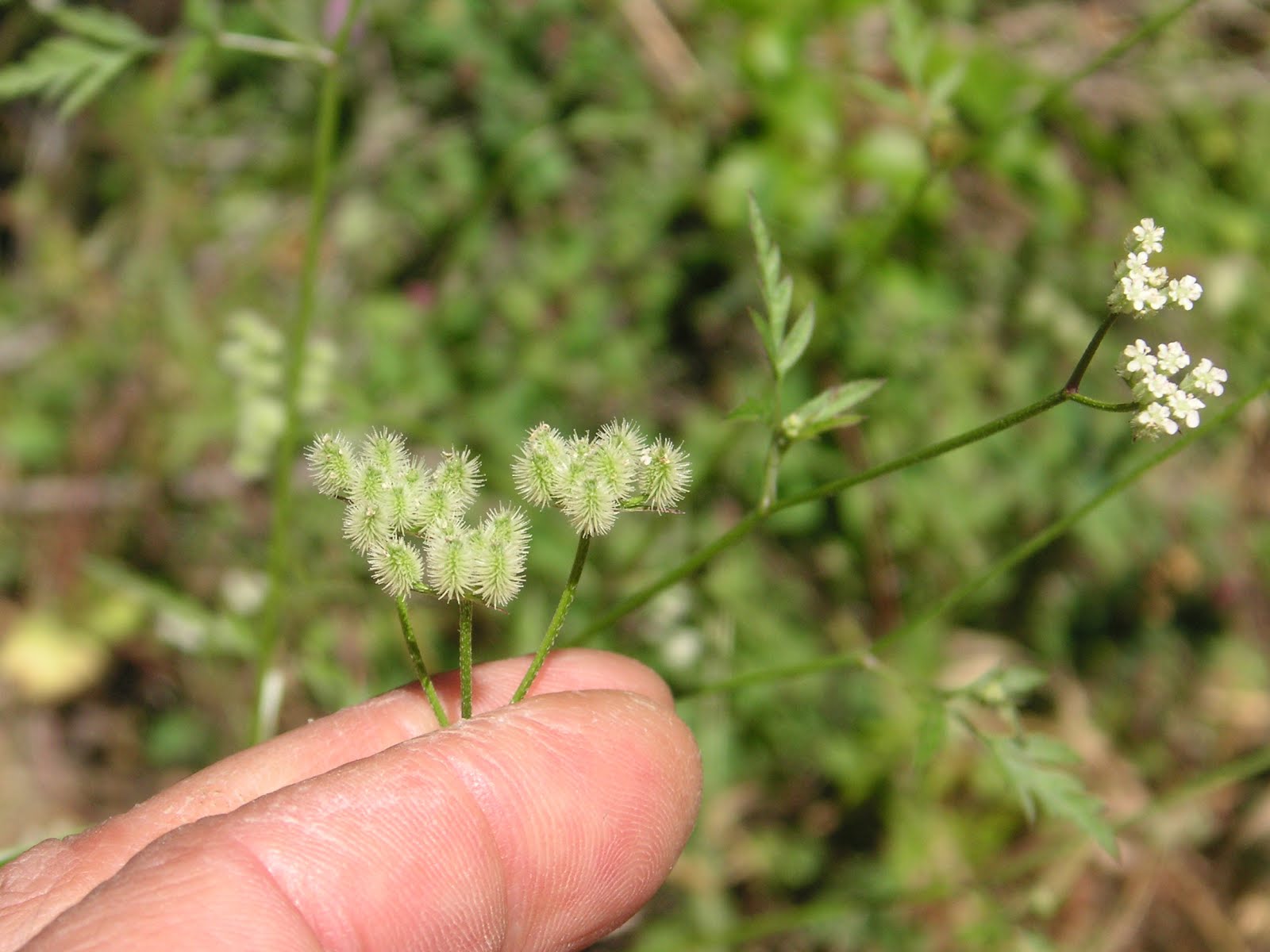
tall sock-destroyer ~ 05/28/12 ~ Fort Ord

Apiaceae

I'm loving the new common name given to this plant by Jepson eFlora. It's very apropos. To see a decent picture of why it could be called a sock-destroyer, check out this photo from CalPhotos.

After looking at numerous online photos of various hedge parsleys, I'm deciding against what David Styer suggested, even though he likely knows the plants of Fort Ord better than anyone else. He thought these were either knotted hedge parsley, aka short sock-destroyer (Torilis nodosa) or CA hedge parsley, aka false carrot (Yabea microcarpa). I compared online pictures with Jepson eFlora descriptions and decided on the tall sock-destroyer ID, because all the flowers and seeds we found here were at the terminal ends of stems (not along the stems like with T. nodosa) and with rays almost the same length (not unequal like with native Y. microcarpa). Since I needed a visual to decipher carrot family part names (like peduncle, ray, and pedicel), I found a great labeled photo of a carrot family member from UBC Biology 324 Blog.

Obviously, hedge parsleys are not the only plants with seeds that stick to fabrics like Velcro. I'm sure their real purpose is to stick to furry animals with equally annoying results to the carrier such that the seeds will be picked at repeatedly until they drop at a new location. David pointed out the similarly looking and closely related bur chervil (Anthriscus caucalis
) and how its seeds have a little pointy end.