Thursday, March 20, 2014

cobweb spider ~ 03/20/14 ~ at home


A couple years ago in October, a friend expressed disgust at the amount of cobwebs around our front door.  He even offered to clean the stairwell for me.  I told him to leave it alone, because I was letting nature do my decorating for Halloween.  Ha!  Truth be told, I'm a lazy housekeeper. Then, last spring when dead crane flies and moths* were accumulating at an excessive rate, I finally did the deed and attacked everything with a broom, vacuum, and a rag.  Quick and dirty. I discovered that a big broom is ineffective against the nickel-sized tan egg sacs that are almost always laid against a corner or crevice.  Bugger.  The spiders dropped and fled for their lives. 

So, I've been watching her up by the porch light the past few months.  I started worrying that she might drop on my head.  Not likely, but still.  This year I decided it was time for Katie's Spider Relocation Program (KSRP) to kick into gear.  I armed myself with an old sock, an old toothbrush, a wide-mouth jar, and a magazine paper advert.  Because of her sticky cobweb, it was really hard to catch her.  I may have accidentally dented her abdomen.  Phooey. Hand-in-sock and the toothbrush worked wonders with removing webbing and those stubborn egg sacs.  She, her eggs, and a smaller male companion are now spending the rest of their days in the neighboring park.

For blogging purposes, I had hoped this was the false black widow (Steatoda grossa).  I can't be sure.  None of my pictures clearly show the markings on the front part of her abdomen.  It looks like there might be a lighter colored stripe that curves around, but it's hard to tell.  I'm satisfied only going to family for ID.  Sonja had me use the a Golden Guide Spiders and Their Kin when I fielded spider ID calls at the museum.  I have the older green cover 1990 edition, and it's still pretty handy if you're not fussed about getting exact species. 

Wednesday, March 19, 2014

Annaphila decia ~ 03/19/14 ~ Pinnacles


More dead animals.  Hey, don't laugh at my photos, okay?  I should have asked for better lighting; the busy office was incredibly dark.  Getting decent pics is a crapshoot for me, as is evidenced by my crappy photos label.  I have zero interest in photography itself.  However, looking at my photo set compared to the standard is making me feel a bit embarrassed that I didn't take the time to line them up perfectly, properly sized, lighted, etc.  Eh, as it was, it took me a good 2-hour visit to take photos of a few trays' worth of Paul Johnson's Annaphila specimens, some from the Pinnacles National Park collection and some from his personal collection.  Thank you for your time and attention, Paul!

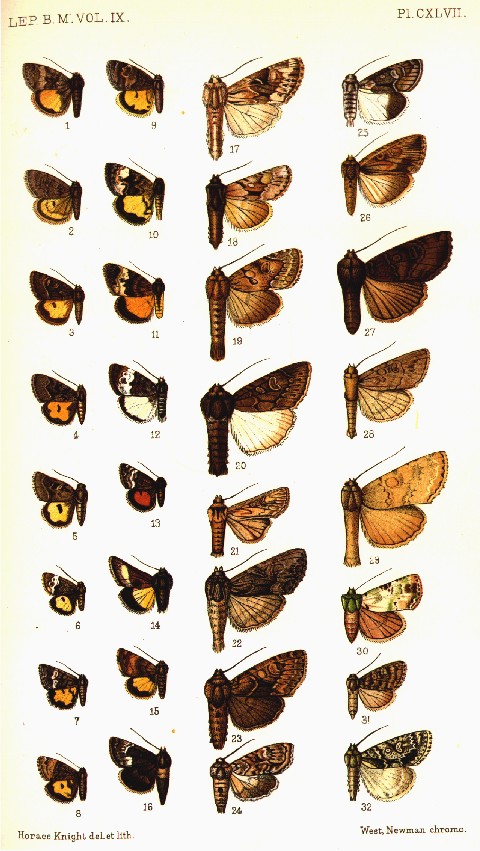
While I prefer alive and natural, over dead and spread, collections do have their uses.  My photos of a live Annaphila from March 9, 2014 match Paul's 4 A. decia specimens, especially compared to the series (scroll down for Annaphila spp.).  There's a distinctive, cartoony sideview of a boy's face on the hindwing, too.  The collection dates were 03/12/02, 03/18/07, and 2x 04/13/06 (yes, yes, I use mm/dd/yy).  That's good enough for me, even though I still don't think they're well represented online and barely match old hand-drawn plates (Hampson Species Index, figs. 7 & 8).  I did find it interesting that a couple more photos were uploaded to BugGuide in the days since my live post.  It's natural, since they're on the wing now.  And, I also located this gorgeous live shot, despite its misspelling (a challenge of online searching).

Alright, I'll admit I was jumping the gun the other day, fantasizing about how I may have accidentally found a previously undescribed species.  It's funny; I'm not ashamed.  Regardless, it reminded me of an item on my bucket list.  I'm not ready to go down that path now, anyways. Someday, right?  

Annaphila decia head on view

I should mention, it's really difficult to spread tiny moths this well.  Spreading takes good dexterity, talent, patience, and desire.  I have none of those qualities.  It's cool how those upright scales (that looked like jumping spider eyes) are still preserved in the spread body.  Now, all I need to do is find me some jumping spiders...

ps 03/27/14 - I am still researching this and may end up personally comparing with U.C. Berkeley's Essig Museum of Entomology original paratypes, which are accurately identified.  There is a potential that my photos, Paul's specimens, BugGuide, and Flickr are all the same, just not A. decia. Crazy, huh?  Go museums!

Monday, March 10, 2014

habitat ~ 03/10/14 ~ Midpeninsula Regional Open Space District Preserve


Once again, a casual comment on Saturday led to another nature bloggers' get-together... at least, from my perspective.  For Ken @ Nature of a Man and Cindy @ Dipper Ranch this visit was work-related.  One of Ken's CNPS friends Paul also joined us on this hike around a closed MROSD Preserve.  My first impression?  This is not what I expected of the Santa Cruz Mountains.  It was wide open and sunny.  And quiet.  Remember, I live by the ocean with an almost constant backdrop of crashing waves.  Well, it wasn't entirely quiet up in the mountains. There was the incredible sound of wind through trees, speckled with extraordinary songs of birds, and the non-stop, excited chattering of nature nuts.  I say this with complete admiration for my companions.  I was just happy to tag along for the ride.  It was a gorgeous day.  I now have more IDs than I can shake a stick at.  More to come...

coast garter snake ~ 03/10/14 ~ Midpen Preserve

coast garter snake
Thamnophis elegans terrestris
(ssp. of western terrestrial garter snake)

I don't know how to sex snakes, but I'm calling it a she.  She was quick and sought refuge in the pond, but a long-legged herp fellow was quicker on his feet.  We thought the two red dots on her head were a nice addition to a very pretty little snake.

edited 04/01/14 - Thanks to Cindy's comment, I revised the ID from Santa Cruz garter snake (Thamnophis atratus atratus) to best guess a ssp. of the western terrestrial garter snake, the coast.  All 3 ssp. of aquatic garter snakes (T. atratus) do not have any red on their sides like this one clearly shows.  Doh! 

The other possibility would be one of the common garter snakes (T. sirtalis).  While Cindy says CA red-sided (T. sirtalis infernalis), I lean towards valley (T. sirtalis fitchi).  Look at this picture and tell me it doesn't look the same with that large eye and black wedges?  Well, okay, the individual shown above has 8 labial palps (typ. of western terrestrial, elegans), rather than only 7 (typ. of common, sirtalis), but that's apparently not 100% diagnostic.  Plus, neither T. sirtalis ssp. is supposed to be found in this area of the Santa Cruz Mountains, and we're confident, somehow, that this is not the endangered San Francisco garter snake (T. sirtalis tetrataenia). Confused, yet?  Join the club!

For a handy-dandy key to CA garter snakes, check out CA Herps.  And, for a brief summary of the confusion around garter snakes (with links) check out my CA red-sided post from Fort Ord.