Showing posts with label x: Hatton Canyon State Property. Show all posts

Wednesday, May 28, 2014

oreas comma ~ 05/28/14 ~ Hatton Canyon


posted 06/30/14 - I only knew which anglewing this was (the other one found at Hatton is the lighter satyr comma), because Chris Tenney told me.  I think he's proud of the oreas being here.  For some reason, outside of our local area the hoary comma, aka zephyr anglewing (Polygonia gracilis zephyrus) is reported.  During the Monterey Butterfly Count on June 7, Paul Johnson took a picture of the first reported hoary comma in recent memory, and it's also lighter than shown above.  There was much trading of photographs and opinions.  I think telling them apart is quite confusing, and the flux of taxonomy shows it confuses the experts, too.

Friday, February 21, 2014

western blacklegged tick ~ 02/21/14 ~ Hatton Canyon

female western blacklegged tick (lookalike in eastern US - deer tick)
Ixodes pacificus (lookalike in eastern US - Ixodes scapularis)

posted 02/27/14 - I remember hearing adult female blacklegged ticks are about the size of a sesame seed, so I thought I'd compare.  Yep.  It's 2 or 3 mm long, depending on if you include the relatively massive mouth parts.

She is my souvenir from Hatton Canyon.  Within 4 hours after strolling through the canyon, my left side began to feel really sore, as if I just had a vaccine shot that gives a strong punch.  I've been generally achy all over anyways due to lingering bike accident injuries, so I kind of brushed it off.  But it kept hurting more and more, so I took a look in the mirror.  Heey, I don't have a mole in that location.  What is that?  Ooof, a tick!  

My immediate reaction was to pull it off immediately.  I think you're supposed to be careful in how you do it, so as not to break off mouth parts or inadvertently squeeze any potential bacteria into the bite wound.  Eh, that's not my instinct.  Get it out, now!  I broke a couple of her legs in the process, as you can see in the picture.  It amazes me how they can get their mouth parts so far into the skin.

I've only ever been bitten by a tick twice before (that I know of), once on my eyelash line while camping on a friend's farm in southern Ohio (I thought the shadow in my view was a crusty chunk of sleep), and another in my butt crack from a day trip to Rocky Creek (it felt like a wedgie). Neither of those bites hurt at all.  So, I was really surprised at what a punch this one gave me for a little more than 24 hours after tick removal.  I kept saying, "I can't believe how much it hurts."  Thankfully, it doesn't hurt at all now.

I'm generally pretty diligent in doing tick checks, which can also be fun with a partner. Who knew "tick check, tick check" could be a bedroom call?  Eh-hem.  But this time, it didn't occur to me I had been on a "hike", so I didn't check, even though Hatton Canyon habitat matches tick territory to a T.  Doh!

bite site on torso 24 hours after removal of tick

No, that's not my boob.  Had to use a flashlight to get a clear shot of the bite site.  It's exactly the diameter of a pencil eraser.  I'm watching it for infection or a bull's-eye ring. Although, the hypochondriac in me is convinced I'm developing symptoms of anaplasmosis.  I have been feeling less than spectacular this week.

There are a surprising number of tick sites online, and who knows how reliable most of the chat community compiled information is anyways.  Lyme disease gets a lot of publicity, but it's not the only tickborne disease.  In addition to my standard links in the ID above, I want to call out a few reputable sites by name (click around, they did an excellent job!):

And lastly, for a parasite souvenir to beat them all, check out fellow blogger Camera Trapping Campus' bot flies from Belize.

ps 03/08/14 - TickEncounter contacted me fairly quickly confirming my ID and asking what type of seed was in the picture I submitted via their online form.  I replied with a link to here.  Whoa!  Whoever is writing me sure has a lot of character.  S/he is incredibly interested in Garrapata State Park, which means "tick" in Spanish.  I gave them local CNPS and FOG contact information, folks I figured would be most familiar with Garrapata's ticks.  They also asked me if they could adapt my blog post for TickEncounter.  Sure.

With their permission and edit (which I found curious), here's what they said, "Thanks Katie for the backstory. One of those other tick bites must have been a western blacklegged tick, too. That earlier bite "primed" you to react like you did.  Our studies suggest strongly that a certain protein or proteins in the tick saliva stimulate an IgE response. On re-exposure, the antigen-bound IgE also binds to basophils through their Fc receptors, activating the basophils to release their "payload" of histamine and other cytokines--resulting in the immediate type hypersensitivity rxn that your body so aptly displayed.  Itching from a tick bite might seem annoying but hey, if it helps alert you to the tick so you can promptly remove it then maybe its a good thing." 

Well, I have to say I wouldn't call the pain I felt with my bite as "itching".  In any case...  Doh!  A classic Jones-Mote levels of hypersensitivity!  That's why I didn't have a reaction from the first bites of 2 different species of tick, my body hadn't made antigens yet.  It's interesting that my initial lack of reactions look like they're specific to the type of tick (Ohio does not have I. pacificus).  I barely remember this from my Medical Entomology class (I think professionals use another reaction model now besides Jones-Mote), but the first time someone gets bitten by certain insects and related, they will not have a reaction.  None.  I'm serious.  Hence why I think so many diagnosed with Lyme disease never even knew they had been bitten by a tick.  Given enough time (~2 weeks?) for the body to create antigens, there will be an immediate reaction upon the 2nd bite.  More bites?  Then a delayed reaction after a day or more.  Eventually if bitten, like constantly, the body will go back to not having a reaction at all.  Crazy, huh?  (Disclaimer: I could totally be recalling this incorrectly, but I can't find anything online that isn't bogged down in immunoglobulin gobbledygook.)

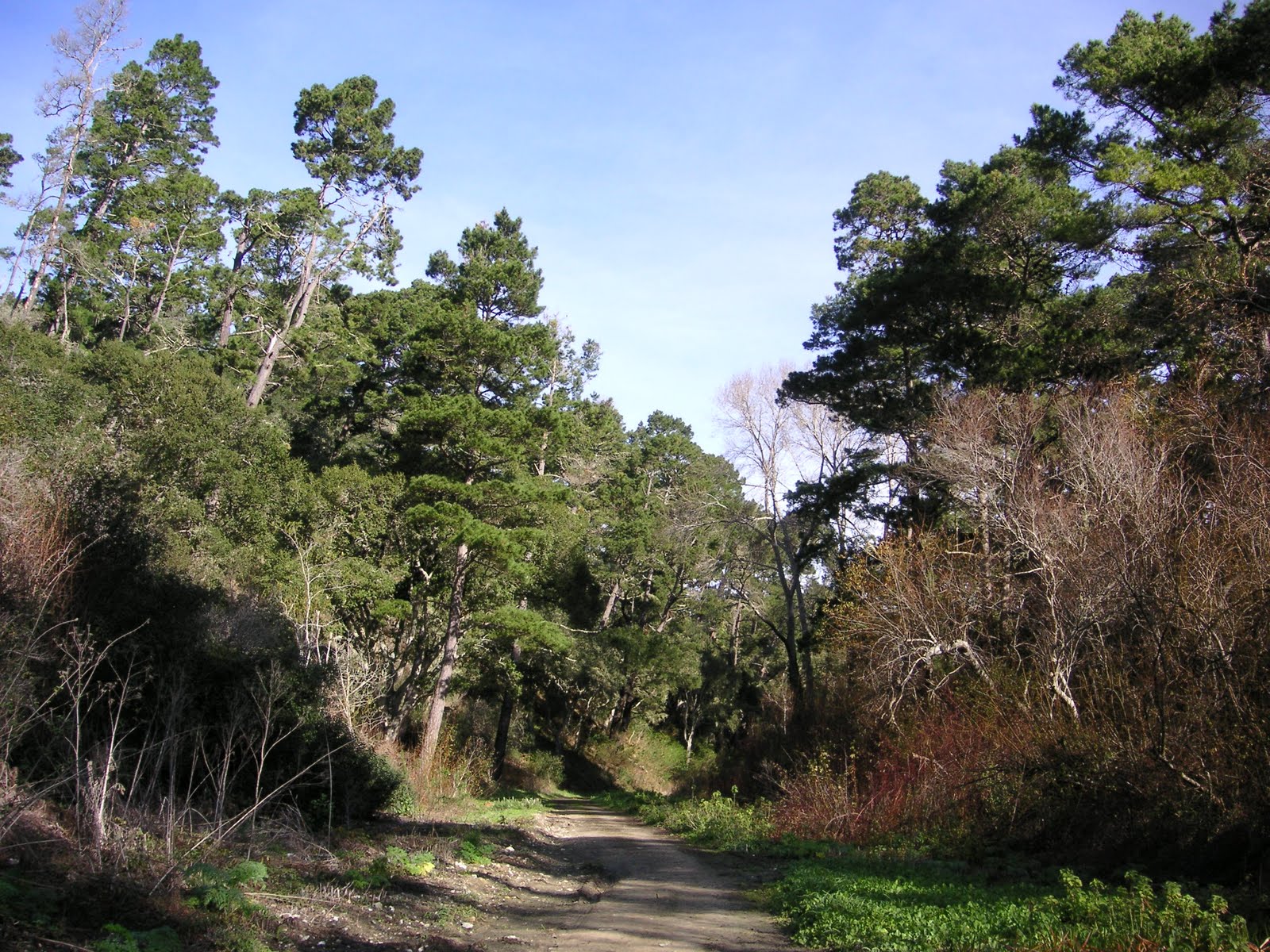
habitat ~ 02/21/14 ~ Hatton Canyon State Property

Hatton Canyon State Park Property
February 21, 2014

Heavy sigh... patience is a virtue I am frequently short on.  Whatever happened to the plans to pave a bike trail here?  Does anything ever get done anymore?  Seriously, I look around at every level of government and wonder how do we actually make progress?  How did they do it during so much turmoil in the 30's and 40's?  My uncle, the archetypal retired history teacher, talks all the time about how our current situation parallels that era.  I don't have an answer, mainly because there's so much I simply don't understand.  I'm putting all my faith in the people who claim they want to figure it out and get it done, i.e, elected officials.  Groan.

Where was I?  Oh, yeah... the best accounting of the bike path drama I could find is this July 23, 2008 Herald article hosted by the Transportation Agency for Monterey County (TAMC).  Erg.  I'm totally guessing a handful of homeowners may be threatening a lawsuit that CA State Parks can ill afford, if it's not currently being battled out.  I'm not sure why I hold such a bad opinion of some local homeowners, but, in their defense, they're often unduly cowed by the cities they live in.  However, they already won in court while rejecting a Hwy 1 reroute through Hatton Canyon back in 1997.  I'm glad they saved the canyon, but the predicted result has been horrific highway gridlock, especially around the high school and during regular commuter hours.  My understanding is that as part of the agreement of land transfer from Caltrans to State Parks in 2001 (scroll halfway down page), the bike path legally has to be put in as a condition of not building the Hwy there.  Poor State Parks can't even provide an online description of Hatton Canyon after 13 years.  So, who has more rights, the homeowners with all their negativity towards change, who I might point out technically do not own Hatton Canyon, or the people of California?  Who has more money?

As a daily user of the extremely successful Rec Trail, I am totally for this new bike path.  Currently, there is no easy way to get from Monterey/PG to the Mouth of the Valley by bike or on foot without having to traverse busy sections of Hwy 1.  Andy and his Saturday morning, trail-running cohorts have tried several times to find a better route, with no success.  I'm sure there are plenty of people who would prefer biking to work or school through a beautiful wooded area, rather than sitting in stinky exhaust, standstill traffic.  Isn't that a good thing?  For every commuter bicyclist, there's gotta be one less car on the road.  I would think the surrounding homeowners would find they prefer reduced traffic congestion and a way to get from place to place without getting in the car themselves.  Maybe the problem lies in connecting the trail safely on the north end, closer to Hwy 68?

As it is, Hatton Canyon is being used as a personal dog pooping park with private trails to many backyards.  I'm wondering if someone with enough money wants to keep it that way, despite the total neglect otherwise.  Fortunately, I saw very little dog poop this time compared to the first time I visited Hatton Canyon.  I don't know if the new dog poop bag dispensers have anything to do with the improvement.  Who pays and supplies the bags?  The whole thing is ironic, because there's been so much vocal opposition to putting in a dog park in Carmel Valley.  Obviously, our area needs one.

I'd love to see some attention and management paid to this lovely spot.  There is so much potential!  Here's the Carmel Area State Parks General Plan from 2012 that looks interesting. As I was searching for information, I noticed the Big Sur Land Trust has quietly removed themselves since the last time I wrote about thisRana Creek has been involved, too.  Their work is distinctive, and I've seen them really grow as a company in the 11 years I've been in the area.  I personally think the Monterey Peninsula Regional Park District (MPRPD) would do an excellent job at balancing nature, access, and the neighbors at Hatton Canyon, but it's not their property to manage.  However, this kind of arrangement is not without precedent - the Morro Bay Golf Course is run by the San Luis Obispo County Parks on CA State Parks property.  If given my druthers, an agreement between MPRPD and CA State Parks could be a great solution.

Sigh... it's been difficult to find any information, so I honestly don't know what the current situation is.  I'm writing someone, TAMC or the District 5 County Supervisor Potter, to find out.  It's such a shame this lovely public land isn't being better utilized.

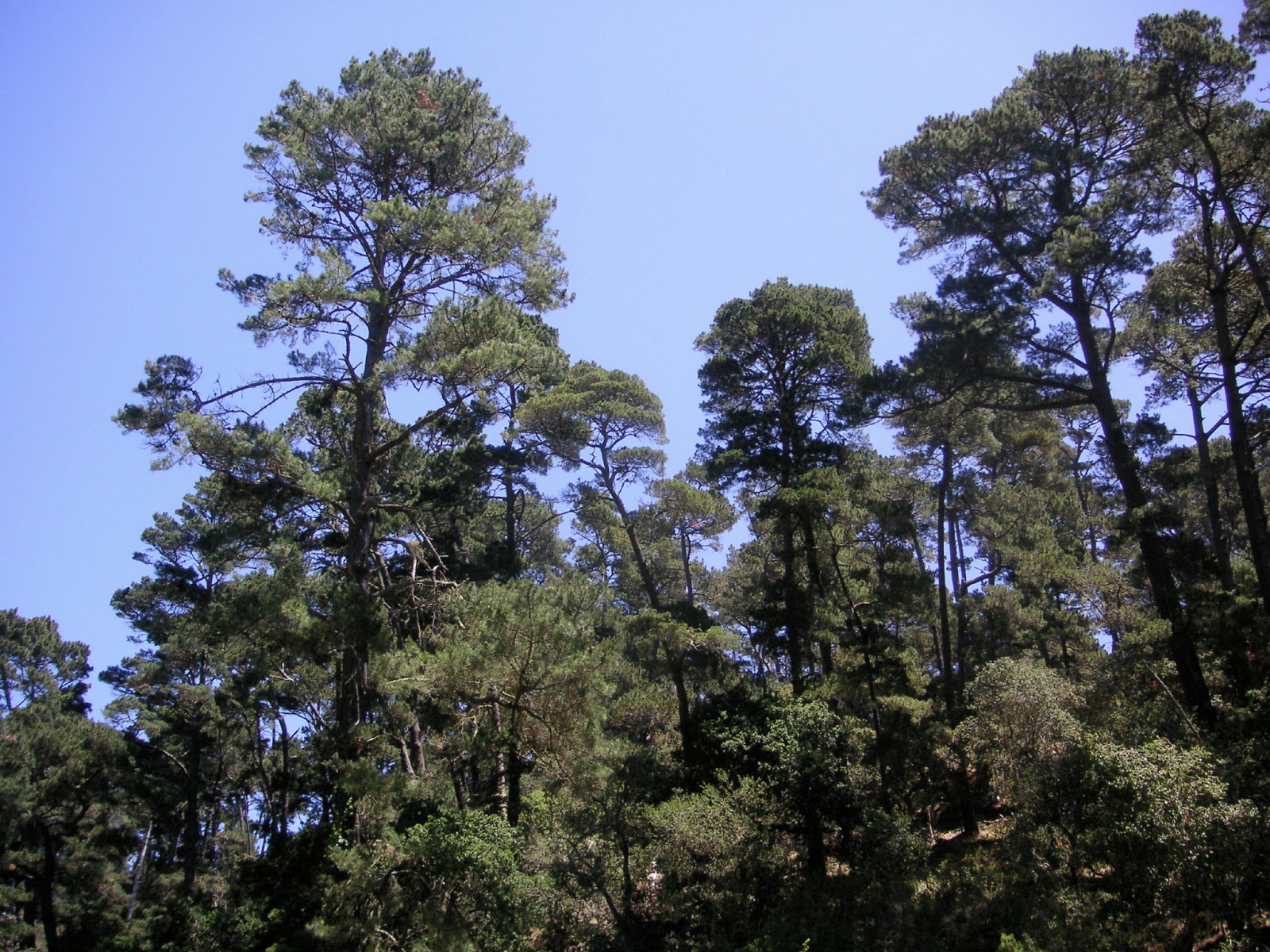
Some things to note on my pictures above...  It just occurred to me that the year-round crick of water is Hatton Creek, which provides a lush green that is hard to find right now during our severe drought.  Someone must be using this water, because there are pipes and manholes scattered throughout the property. Are the Hatton Canyon environmental lawsuits a facade for water rights?  I'm not serious, but nothing would surprise me anymore.  I'm including the oaks above, because I've neglected them in previous habitat posts.  And, the Monterey pines are looking sorry indeed with lots of dried up parts.  I'm looking forward to more rain.

ps 02/27/14 - I apologize if anyone's blog feed got messed up.  I edited this a gazillion times, because I kept finding biased errors in my assumptions.  I feel a sense of responsibility in getting my facts straight when expressing my opinions.  I'm sure there's a lot I don't understand.

Todd Muck, Deputy Executive Director of TAMC, kindly replied to my query and gave me permission to quote him on my blog.  He said, "Due to the opposition to converting the dirt service road into a paved bike path, the Transportation Agency for Monterey County's Board of Directors elected to not construct that portion of the project when we constructed the tunnel under Carmel Valley Road and the paved path to Rio Road.  The unpaved portion remains in TAMC's Bicycle and Pedestrian Master Plan as a potential future project, but there is no longer any funding dedicated to pursing the project."  He also pointed me in the direction of Victoria Beach, a Carmel City Council Member, who's organizing a citizens trails group.  Interesting.  I'll check it out.

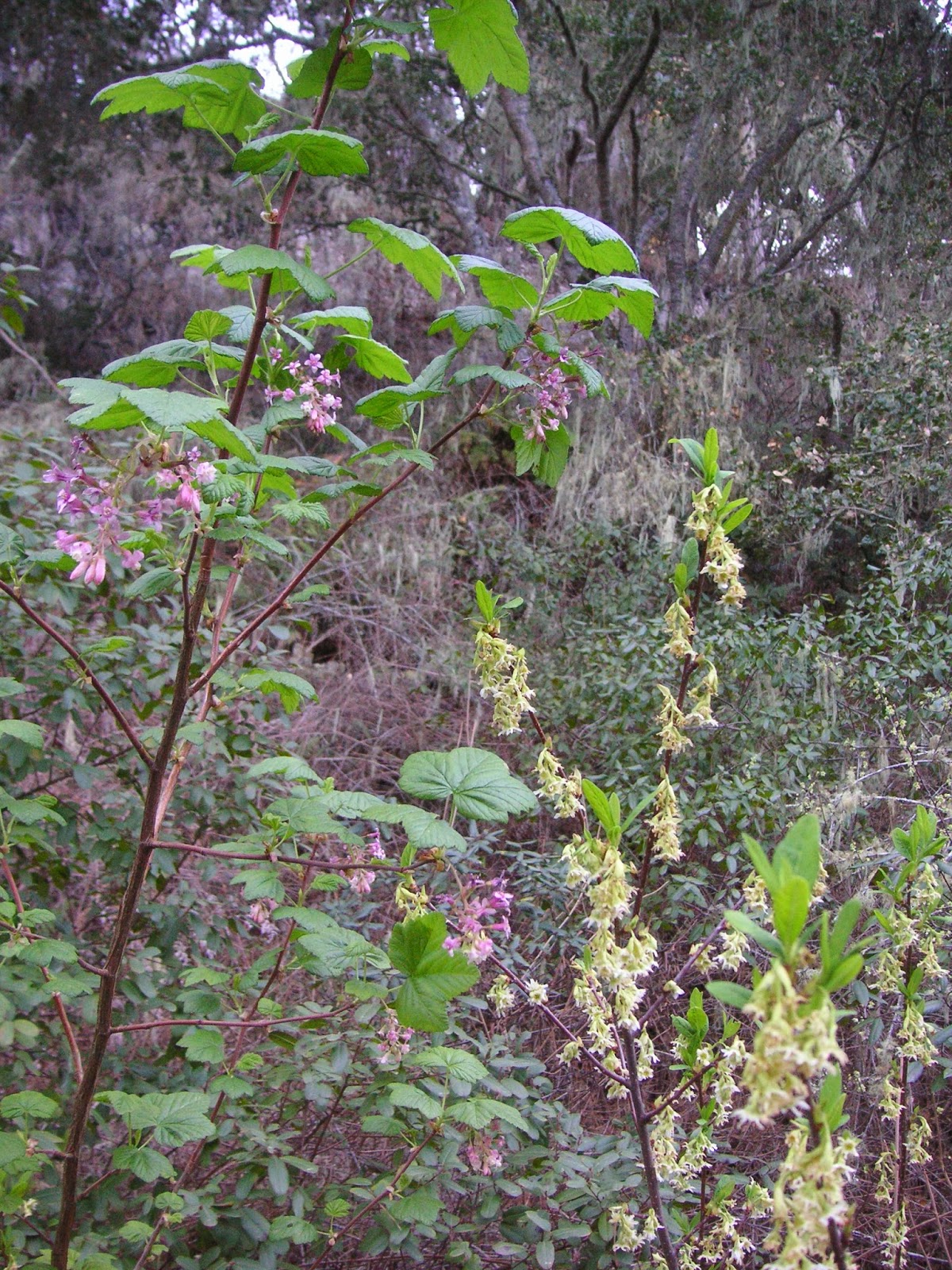
oso berry ~ 02/21/14 ~ Hatton Canyon

Rosaceae

Here's another shrub I've wanted to ID for a while.  It's delicate and pretty and one of only a handful of plants in bloom right now.  We noticed the oso berry tends to grow in the same spots as the pink flowering currant.  Oso berry is missing from the local CNPS Hatton Canyon plant list. Las Pilitas Nursery (linked in the aka above) states, "Crushed foliage smells like a green watermelon."  Oooh, I'll have to take a whiff the next time.

Victorian box ~ 02/21/14 ~ Hatton Canyon


I've seen this large shrub at different locations and wondered what it was.  My first thought when seeing it is coffeeberry.  Nope.  When it's in bloom, it reminds me of an orange tree.  And, I've tasted the bright red seeds.  Blech!  After several half-hearted attempts at IDing old photos, I finally resorted to a google image search for "orange berry tree wide wavy leaves".  Ta-da!  (Goodness, what did I do before google?  Anyone remember the World Book encyclopedia?)  I liked Trees of Santa Cruz County's blog post on Victorian box.  This garden escapee hails from eastern coastal Australia and has been locally reported at Jacks Peak and the Frog Pond.

CA manroot ~ 02/21/14 ~ Hatton Canyon

Marah fabacea (aka M. fabaceus)
Cucurbitaceae

My friend thought this was the dreaded cape ivy (Delairea odorata), because of the shape of the leaves and the viney way it was growing.  It does look similar.  However, I was pretty sure it was wild cucumber, but realized I never really paid close attention to either plant before.  If I hadn't found the prickly fruit, I might have been convinced otherwise.  Really, what do I know?  I'm continually learning.  There are 5 spp. of Marah found in CA, and the relatively flat corolla (rotate vs. cup-shaped) tells me this is M. fabacea.  Btw, cape ivy has yellow flowers and shiny leaves

Friday, May 31, 2013

habitat ~ 05/31/13 ~ Hatton Canyon State Property


After I first visited Hatton Canyon back on February 4, 2011, I wasn't terribly impressed by the proliferation of non-native plants and haven't had a huge desire to return.  I do remember the auditory intensity of bird songs, which prompted a second worthwhile visit this past March 10. Unfortunately without accompanying photos, it didn't inspire me enough to break out of my winter blogging hiatus to write about the birds.  Then when Monterey County butterfly guy Chris Tenney and I were figuring out where to meet for the first time, he suggested Hatton.  Oh? Turns out this place is a butterfly hot spot.  So, while there are mostly invasive plants, like poison hemlock, nestled adjacent to rare native stands of Monterey pines, the fauna density is quite impressive.  It's amazing what a few short years can do to change my opinions. I was starting to get sucked into nativism, just shy of biological xenophobia, something that's been in the forefront of my consciousness lately.  Maybe it doesn't really matter, beyond the concerns of humans, if the thriving plants originated here or elsewhere?  The animals certainly don't seem to mind too much.  Maybe it's better to let nature run its course?

gray hairstreak ~ 05/31/13 ~ Hatton Canyon

 
for more information, click here and here

I have a strange compulsion to want to watch hairstreaks and closely related blues rub their hindwings together, similarly to how I like to watch cats clean their faces by licking their paws. It's my understanding that the prevailing hypothesis for why they do this is "false head" complete with eyespots and fake antennae to detract would-be predators from the real deal.  But, what about bramble hairstreaks and blues that do not have eyespots or tails and still rub their wings together?  In any case, I was quite charmed by this little gray hairstreak casually rubbing those rear wings with the tails even getting tangled together.

field crescent ~ 05/31/13 ~ Hatton Canyon


Grrr. All these naming variations are starting to really annoy me.  Once again, the common name is the best identifier.  BugGuide has a succinct explanation for why the multiple sp. names of the field crescent exist.  Based on what Chris Tenney told me, I knew this was the darker field crescent, as opposed to the orange and highly variable Mylitta crescent, which we also saw on this outing. Underside, they're both a patterned pale orange.  However, the orange-tipped antennae (click on pic to enlarge) tripped me up upon closer inspection. Even Jeffrey Glassberg in his multiple books has changed his tune about field crescents always having black antennal tips - they don't always.  It's posts like this that make me question why I'm even bothering with Nature ID.  Sigh.

satyr comma ~ 05/31/13 ~ Hatton Canyon


It's always a thrill for me when I can get close enough to a comma butterfly to actually see the bright white comma mark on the underside of the hindwing.  We also spotted an oreas comma (Polygonia oreas, aka Polygonia progne oreas, more information) at Hatton Canyon, and I had hoped my second picture above was from that sighting.  Nope.  From the topside, the satyr comma has a black spot smack in the center of the hindwing, underneath the two spots along the leading margin.  It's easier to tell the difference between the two from the underside. The oreas is almost dark grey and the comma mark is shaped more like a boomerang, rather than the fish hook of the satyr.  There's really so many subtle variations of Polygonia in North America that these descriptions wouldn't necessarily work when comparing to other spp.

Lorquin's admiral ~ 05/31/13 ~ Hatton Canyon

for more information, click here and here

Lorquin's lacks the black.  Lorquin's lacks the black.  Lorquin's lacks the black.  I made up this mnemonic a couple years ago when I was trying to remember the difference between these admiral butterflies and the very similar looking California sister.  I've repeated it constantly.  Still, it hasn't really helped me differentiate Lorquin's when they're quickly flying past, so this is my first confirmed sighting.  I'm fairly sure I've seen Lorquin's before but usually guess they're the more common CA sister.  The lacking the black refers to the orange going all the way to the wing tips, without a thick dark border as is found on CA sisters.  Both butterflies tend to be in flight at the same time, too. Apparently, Lorquin's are Batesian mimics of the CA sister.

Friday, February 4, 2011

habitat ~ 02/04/11 ~ Hatton Canyon State Property


Hatton Canyon State Park Property
February 4, 2011

There's been quite a bit of local controversy over Hatton Canyon from Caltrans to State Park ownership. Now, I hear there's more controversy over paving a trail through the canyon for bicycle access and concerns about a ban on being able to walk your dog on State Park property's unpaved trails. I have to say we spotted dog poo everywhere, which doesn't do the pro-dog folks any favors. Until I get my facts straight and instead of simply repeating what others have already written, here are 2 links that provide some basic information: Walking and Hiking on the Monterey Peninsula (scroll down 1/3 of the page) and Big Sur Land Trust. During this hike, we accessed the canyon through the newly constructed tunnel under Carmel Valley Road at Highway 1. Given the proliferation of invasive plant species here, it is definitely land that could use some management.

ps 02/26/14 - My original link to the Big Sur Land Trust no longer exists.  It was an informative page about how they're connecting trails.  I wonder what happened.  Instead, here's a nice map of the area under BSLT purview.  And here's a more recent Hatton Canyon habitat post.

dusky-footed woodrat house ~ 02/04/11 ~ Hatton Canyon

dusky-footed woodrat house
Neotoma fuscipes

Thanks to my previous unknown nest or den post and Flickr commenters, I've learned these massive twig structures are not merely haphazard collections of twigs. Now, I recognize dusky-footed woodrat houses everywhere. Apparently, some groups even have up to 3-15 houses with different purposed chambers, such as nesting, latrines, and storing food and collected treasures. Did you know they're also called packrats? Ah, so that's where the term comes from. I know some people who are packrats, eh-hem. Google images to find more pictures of these stick houses; they can also be found under the name Neotoma macrotis (don't know what that's about). And, for a much better blog post about dusky-footed woodrats than I could ever do, check out The Nature of a Man.

ps 07/06/11 ~ For another species, desert woodrat (N. bryanti) and its middens , check out The Nature of a Man's east Mojave trip.

pss 02/15/12 - I removed the The Davidson College Biology embedded links, which were very informative, but is now unavailable. I suspect the professor either retired or moved to another university.

Apparently, my best pics of birds are when they're dead and don't move. I was sad to find this dead bird, but it did make identification very easy. It must have recently died, because its body was still pliable. Now, aren't you glad to not be my husband and hold my hand afterward? Hatton Canyon was an incredible find for listening to a cacophony of bird songs. In fact, I don't ever recall hearing so many birds, anywhere, and I've been places! It's too bad this was the only bird I managed to photograph during our hike. I strongly suspect that all those fancy gardens on the hills also have bird feeders. As a side note, Cornell's All About Birds (linked in the scientific name above) shows this bird as a winter migrant, whereas my handy-dandy bird book at home shows the exact opposite range map of year round vs. winter (still unnamed on my blog, because I worry about its accuracy - I'm badly attempting to follow that policy of if you can't say anything nice, then don't say anything at all). So, which is correct?

western dogwood ~ 02/04/11 ~ Hatton Canyon


OK, I'm getting pooped out on ID'ing plants for today. Does anyone know what these are? The green to red stems were gorgeous!

ps 02/10/11 - I originally posted this as unknown green and red stems. Thanks to Cindy at Dipper Ranch, I was able to track down the ID. I did a search query on which kinds of Cornus are found in this area and the subspecies occidentalis is the only one on record. That's good enough for me. As is becoming my custom, I obtained the common name from Jepson; I didn't like red-osier as a descriptor, because it makes it sound like it's a willow. I've made the corrections to the ID above and made a comment below.

fuchsia-flowered gooseberry
Ribes speciosum
Grossulariaceae

Finally, a native wildflower! Apparently, gooseberries are edible... if you can get past the spiny fruit. For a nice blog post of eating gooseberries (note: not the same species as shown above), check out Rooted in California.

French broom
Genista monspessulana
Fabaceae

Every time I see brooms alongside the roads, I am inexplicably reminded of the early spring yellow forsythias in Ohio. While not quite as all-over yellow as the forsythias, brooms are definitely spring bloomers. There are several species of brooms in our area, most non-native and a couple natives. From past visits to our local annual wildflower show in April, I remember them being named after European origins (Spanish, Scotch, Portuguese...).

scarlet pimpernel
Anagallis arvensis
Primulaceae

Here's another non-native wildflower. Oy! Please note, the first picture was taken mainly to show this tiny flower up close and is not related to the unidentified prickly plant the bloom is resting on. It is apparently also know as the poor man's weatherglass due to it only opening on sunny days. I'm guessing the scarlet pimpernel comes from Europe. I didn't know it also has a blue or white version. Cool.


summer field mustard
Hirschfeldia incana
Brassicaceae

These were not technically in Hatton Canyon and were located across Carmel Valley Road. Don't quote me on this ID. I really should take a flower ID class. I'm trying to get over my prejudice for invasive non-native plant species. It's not their fault for being so successful. Of course, I'm not in the business of restoring habitats, either. Taken at face value, they really are quite pretty and extraordinarily common.

ps - I've added a postscript to an older mustard post, but will repeat it here. For plants, I often use the common names according to The Jepson Online Interchange from UC Berkeley, e.g., click to see the page for this particular species. I've found both Calflora (often embedded in scientific name ID) and CalPhotos (often embedded in common name ID) to be inconsistent in their use of common names due to database requirements and a variety of submission sources.

greater periwinkle
Vinca major
Apocynaceae

And yet, another invasive plant but still pretty. It hails from southern Europe.