Showing posts with label brodiaea family. Show all posts

Tuesday, April 8, 2014

pale swallowtail ~ 04/08/14 ~ Pinnacles

for more information click here, here, and here
Themidaceae

Considering how often I am out, I don't often see butterflies totally consumed with nectaring.  My preferred hiking conditions run cloudier, cooler, and earlier than prime nectar flow, aka prime butterfly sipping activity.  My goal this year is to see more butterflies and to get to know, really know, our local spp.  So, I've adjusted my outings to a little later in the day and for warmer temperatures, which include inland locations away from the coastal cool, like Pinnacles National Park.  Thus far, I've had a fair bit of success in finding more butterflies that hold still long enough for me to take a good look at them and a couple of pictures.  I haven't netted in over a decade, because I know I am not a gentle netter and it pained me to injure butterflies just so I could look at them up close.

For Pinnacles, the only 2 reported spp. of striped, yellowish swallowtails are the pale swallowtail (aka Pterourus eurymedon - why?  someone wanted to make it a thing?) and the western tiger swallowtail (Papilio rutulus).  The slightly twisted tail-detail view from on top and from below don't match and can be visually confusing on a quickly moving animal.  Plus, the tails are sometimes broken off. Here's my cheat sheet to tell the two apart:

pale swallowtail                       
true, creamy butter color (real butter, not what you imagine is a butter color)
often with orange coloring in last crescent next to the tail, sometimes yellow

western tiger swallowtail
deeper yellow, like buttercups
always yellow in last crescent next to tail

I've read that the width of their stripes is thicker in pale versus western tiger, but that's tricky to tell when they're not side-by-side to compare.  Although, they reportedly often fly together.

Tuesday, May 14, 2013

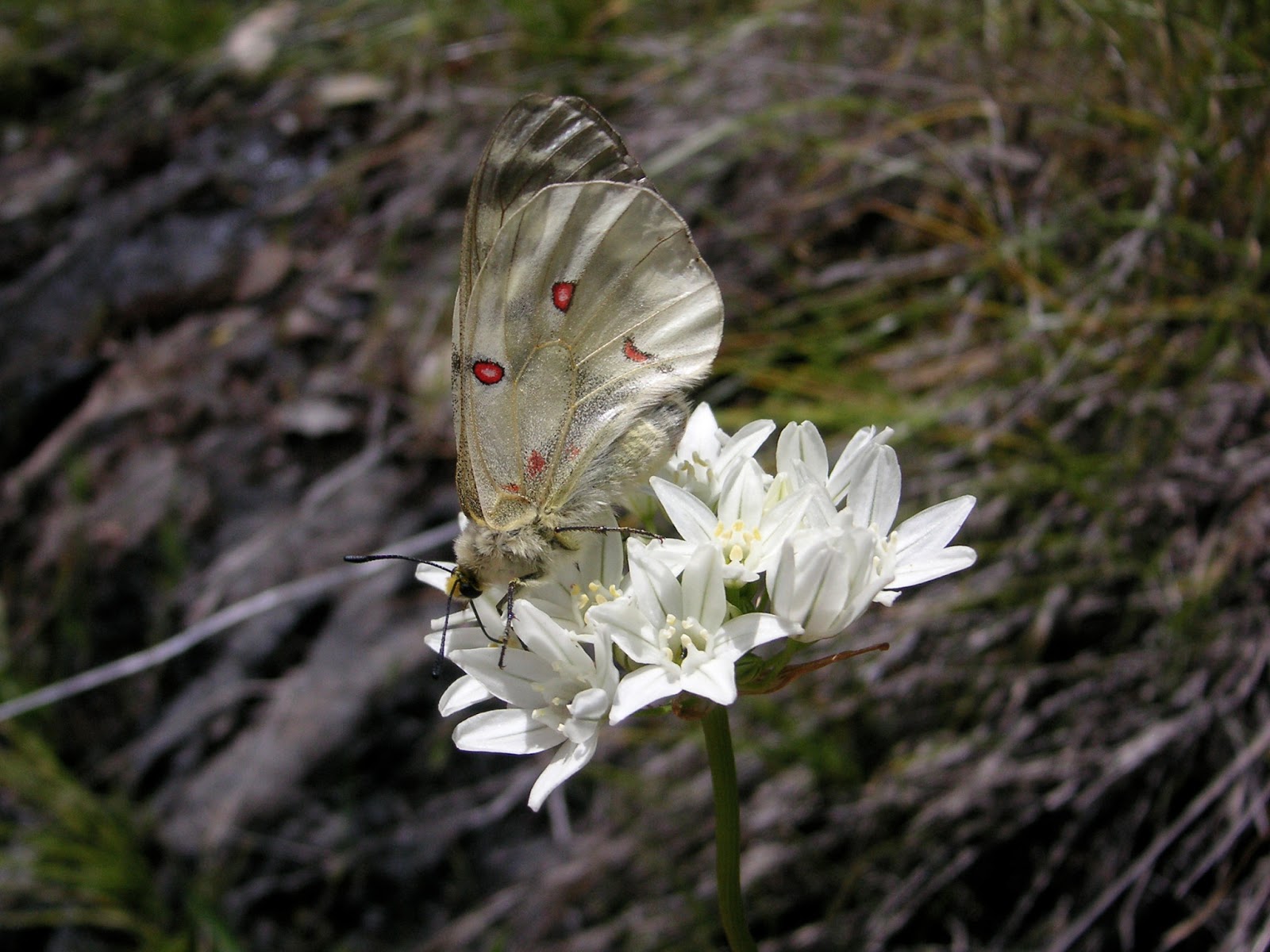
clodius parnassian ~ 05/14/13 ~ Washington

Themidaceae (formerly Liliaceae)

Isn't it pretty? Those red spots make me want to pull out my art markers and draw butterfly spots. When I first saw Parnassius about 15 years ago in the Ohio museum collection where I worked, I initially thought someone had grossly misfiled the drawer in the swallowtail (Papilionidae) cabinet. I figured they should be with the whites and sulphurs (Pieridae). Wrong! They are somehow classified along with swallowtails but in their own subfamily Parnassiinae, aka apollos. After looking at the pinned labels and discovered none were found anywhere near OH and several were collected in CA, I wished I had become more familiar with butterflies before I had left my home state. Not thinking I would ever return to CA at the time, I was a little sad at the prospect that I'd probably never see one on the wing. Wrong, again! When Dr. Shapiro mentioned we might spot early seasonal individuals of this high altitude butterfly, I got very excited. There used to be ssp. strohbeeni in the Santa Cruz Mountains closer to home, but it is now assumed extinct. Sure enough, there were numerous P. clodius ssp. sol fluttering about along the South Yuba River. Yeah! I was amazed at how large they appear. This one looks very fresh and notably still slightly crumpled in the wing. As an additional note, it seems whenever Parnassius are mentioned, the butterfly version of a "closed for business" sphragis is also mentioned. For great pictures and a brief discussion of what this means, check this out.

As for the white brodiaea, I kinda surprised myself at how easily I tracked down its ID. Closer to home the coast pretty faces have made an incredible showing this year, and these white flowers reminded me of them as well as dwarf brodiaeas. I guess I'm getting slightly better at recognizing related plants.

Friday, May 11, 2012

dwarf brodiaea ~ 05/11/12 ~ Fort Ord


dwarf brodiaea
Brodiaea terrestris ssp. terrestris
2011 online Jepson description
Themidaceae (aka Asparagaceae and formerly Liliaceae)

This was my favorite flower from the entire excursion (even though I keep spelling it incorrectly). It was everywhere in the Butterfly Valley vernal pool. I've seen it before, but never knew what it was. The pic with my finger is to show how tiny and close to the ground these beautiful flowers grow. And of course, I had to include one of the several white versions I found, which I pointed out to several students. One fellow who is into plant genetics said that the white versions of flowers are due to a gene being knocked out (don't really know how that happens, and I didn't hear the rest of his explanation).

For the ssp., I'm using the printed list that David Styer passed around. I'm also now including the new 2011 Jepson online descriptions in my IDs, even though it's linked from my usual embedded links to Calflora.org in the scientific plant names. Plus, as I go through plants, I'll be changing all the family names to the 2011 Jepson version, versus the APG versions that are often used on Wikipedia. Jepson seems to be the bible of CA plants for CNPS.

ps 05/21/12 - As Graeme of Imperfect and tense asked in the comments, the even tinier, white Primula-looking sp. growing with the dwarf brodiaea is Hickman's popcorn flower (Plagiobothrys chorisianus var. hickmanii) in Boraginaceae. Click here to see my other popcorn flower posts.

Thursday, June 30, 2011

coast pretty face ~ 06/30/11 ~ Fort Ord

coast pretty face / golden brodiaea
Triteleia ixioides ssp. ixioides

Themidaceae (aka Asparagaceae and formerly Liliaceae)

This pretty face is locally common and looks similar to the related goldenstar I found inland at Pinnacles. There are 5 subspecies of golden brodiaea (T. ixioides), and I used the Fort Ord plant list to narrow this down. For some reason I started calling this "yellow dick" a couple years back, perhaps because it's also related to the blue dick. It's my own made-up name. To read a better blog post of golden brodiaea, check out Sierra Foothill Garden.

Thursday, June 9, 2011

common goldenstar ~ 06/09/11 ~ Pinnacles

common goldenstar
Bloomeria crocea
Themidaceae (aka Asparagaceae and formerly Liliaceae)

When I took this picture, I thought it was coast pretty face, aka golden brodiaea (Triteleia ixioides ssp. ixioides), which is commonly found near home at Fort Ord and Garland Ranch. Nope. Just goes to remind me to take a closer look and to not assume what I see at home is what I see even one county away.

Sunday, March 20, 2011

blue dick ~ 03/20/11 ~ Fort Ord

blue dick
Dichelostemma capitatum ssp. capitatum
Themidaceae (aka Asparagaceae and formerly Liliaceae)

It always amazes me how one or two colors of wildflowers seem to dominate at a time. During this particular hike at Fort Ord, lilacs (blue dicks, ceanothus, fiesta flowers, star tulips, yerba santas) and bright yellows (buttercups, footsteps of spring, oak catkins, sun cups) were everywhere. It's as if Mother Nature only had two tubes of flower paint and also consulted a color wheel.