Showing posts with label asparagus family. Show all posts

Sunday, December 25, 2011

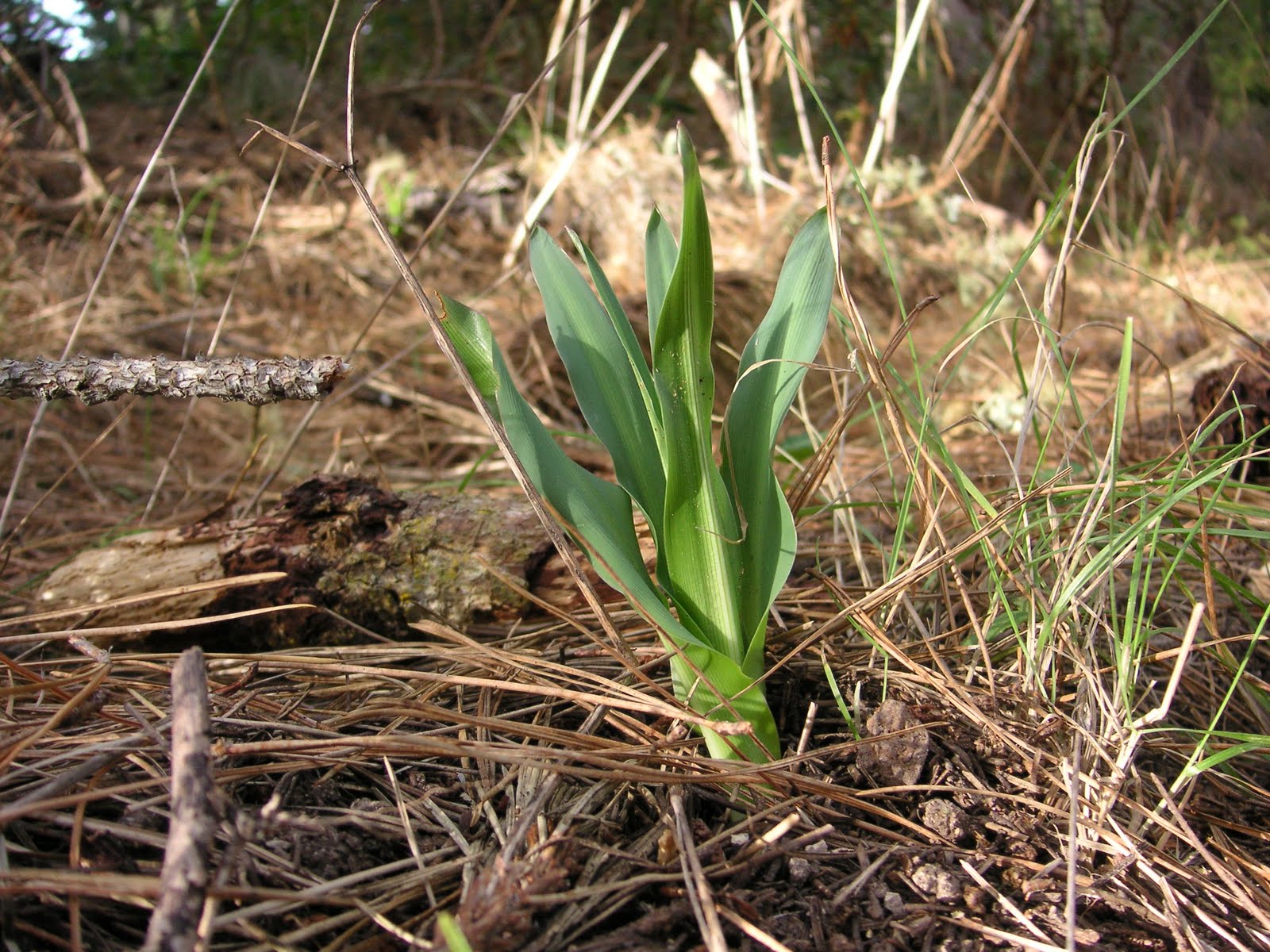
wavyleaf soap plant ~ 12/25/11 ~ Jacks Peak

wavyleaf soap plant
Chlorogalum pomeridianum var. pomeridianum
Asparagaceae (formerly Agavaceae, Hyacinthaceae, & Liliaceae)

Edited 01/03/12 - I originally posted this as a sprout of Fremont's star-lily, but thanks to my commenters, I've corrected the ID above. It's been a goal of mine to track the seasonal evidence of both death camas, aka Fremont's star-lily, and soap plant, especially in areas where they literally grow from the same spot of ground like at Jacks Peak. I've made a fuss about how several online sites have them mixed up, and I've admitted I get them confused, too, when they only have green leaves - the flowers are too distinctive to ever get them mixed up. I've now concluded that death camas is an early flowerer compared to 3-4 months later in the season soap plant.

Thursday, August 4, 2011

wavyleaf soap plant ~ 08/04/11 ~ Jacks Peak


posted 01/03/12 - This is the exact area I photographed death camas back on February 11, 2011. When I took these pictures, especially the middle one above, I truly believed I had finally captured both soap plant and death camas together. Now that I've had the space of time to look at the pictures, all the fallen leaves look like wavyleaf soap plant.

Thursday, July 14, 2011

fat solomon ~ 07/14/11 ~ Garland Ranch

Maianthemum racemosum (aka Smilacina racemosa)
Asparagaceae (formerly Ruscaceae & Liliaceae)

As with slim Solomon, another false Solomon's seal, there's quite the variation of names. The berries are pretty. Most of the fat Solomon we found along the trail had missing berries and stems as shown in the second pic above. I wonder if deer or horses like to eat them. This trail is a popular horse riding route with several stables nearby.

Now here in CA, we don't have actual Solomon's seal. There are numerous websites devoted to herbal uses. Two that have some name origin and historical use information, not soley trying to hard sell you on their products, are Botanical.com (Polygonatum multiflorum native to Europe and Asia) and Cortesia's Solomon Seal blog (P. biflorum native to eastern North America). There's also a nice online chapter of The Book of Herbal Wisdom by Matthew Wood. I wish I could find as much information about indigenous peoples' uses of CA native plants.

ps 07/20/11 - Thanks to Particia Lichen's comment below about the general confusion around Solomon's seal ID, both the real dealio and the false ones, I'm repeating my reply. When I was in OH, I never could remember which had flowers hanging from the underside of the leaf stalks (true) and which had flowers on the ends (false). Until researching for this post I wasn't aware we didn't have Polygonatum (true) here in CA. As for the false Somolon's seals, fat and slim refer to the overall look of the leaves. The one shown above has wide leaves and the slim Solomon has skinnier leaves. Feathery and starry are also descriptive of the look of the flowers. These common name descriptors are helpful to remember since I found both plants in the same park.

Thursday, June 30, 2011

coast pretty face ~ 06/30/11 ~ Fort Ord

coast pretty face / golden brodiaea
Triteleia ixioides ssp. ixioides

Themidaceae (aka Asparagaceae and formerly Liliaceae)

This pretty face is locally common and looks similar to the related goldenstar I found inland at Pinnacles. There are 5 subspecies of golden brodiaea (T. ixioides), and I used the Fort Ord plant list to narrow this down. For some reason I started calling this "yellow dick" a couple years back, perhaps because it's also related to the blue dick. It's my own made-up name. To read a better blog post of golden brodiaea, check out Sierra Foothill Garden.

Thursday, June 9, 2011

common goldenstar ~ 06/09/11 ~ Pinnacles

common goldenstar
Bloomeria crocea
Themidaceae (aka Asparagaceae and formerly Liliaceae)

When I took this picture, I thought it was coast pretty face, aka golden brodiaea (Triteleia ixioides ssp. ixioides), which is commonly found near home at Fort Ord and Garland Ranch. Nope. Just goes to remind me to take a closer look and to not assume what I see at home is what I see even one county away.

Friday, April 8, 2011

slim solomon ~ 04/08/11 ~ Garland Ranch


OK, folks, I'm starting to get extremely irritated by all these naming changes. I thought this would be a simple post to quickly pump out this morning with perhaps a mention of the biblical reference in the common name, but, oh no, there's been a massive reclassification - not only family (x2!), but genus, species, and common names as well. Now, I'm wondering if the collective is actually talking about the same plant, since some of the photos available online do not look like each other, with one being upright and stiff and the other being loungy and relaxed (as shown in my pics above). I can understand how the official written descriptions can apply to both. Here's where I think actual photographs help clarify where words and archaic terminology can be interpreted differently. Erg. This lovely moist hillside find is often published in a variety of books as Smilacina stellata under the family Liliaceae; good luck if you can find it in an index with all its various names.

ps 07/17/11 - I edited the names and embedded links above, because even I was starting to confuse myself. For a closely related plant, see my fat Solomon post.
As an added note, the green berries of the slim Solomon have 3 dark stripes.

Sunday, March 20, 2011

blue dick ~ 03/20/11 ~ Fort Ord

blue dick
Dichelostemma capitatum ssp. capitatum
Themidaceae (aka Asparagaceae and formerly Liliaceae)

It always amazes me how one or two colors of wildflowers seem to dominate at a time. During this particular hike at Fort Ord, lilacs (blue dicks, ceanothus, fiesta flowers, star tulips, yerba santas) and bright yellows (buttercups, footsteps of spring, oak catkins, sun cups) were everywhere. It's as if Mother Nature only had two tubes of flower paint and also consulted a color wheel.

Friday, February 11, 2011

Sunday, July 25, 2010

wavyleaf soap plant ~ 07/25/10 ~ Washington Park


posted 07/30/11 - Last year I missed the blooms on this soap plant as it was likely too early in the day. Since the flowers only last one night, I wonder how long it takes before the seeds form. Without a plant list, I don't know which 2 of the 3 varieties this would be. Both var. divaricatum and var. pomeridianum are found in Monterey County.