Showing posts with label x: Jacks Peak County Park. Show all posts

Monday, March 31, 2014

habitat ~ 03/31/14 ~ Jacks Peak County Park

Jacks Peak County Park
March 31, 2014

posted 04/04/14 - Zowie!  The poison-oak is going gangbusters, creeping over everything on the lower slopes of my favorite access trail to Jacks Peak.  Within 2 days of this visit, I may have developed my first-ever poison-oak rash.  Bummer.  They're just little red bumps that itch like crazy, nothing like the oozing sores Andy gets weeks later from his trail running in shorts.

Under all that poison-oak in the first photo, there's also a dusky-footed woodrat stick midden on the fallen trunk.  I find it interesting that some of them prefer to build their houses up off the ground.  I'm so happy the bright spring green has finally arrived.  A little late, but I'll take it.  And, thanks to having recently hiked in a different kind of pine forest at Lewis Creek and seeing the contrast, I now recognize there are sections of the access trail that have absolutely nothing growing down below.  It feels really old and static in there with feet deep, cushy soft layers of pine needles.  The Monterey Peninsula is famously referenced as one of the last remaining stands of native Monterey pine with Jacks Peak crowning it all.

Monday, December 23, 2013

habitat ~ 12/23/13 ~ Jacks Peak County Park

December 23, 2013

It's as if someone pushed the pause button on the seasons.  While the evergreen coast live oaks seem to be holding their own as usual, the Monterey pines look thinner and yellower around the edges.  Closer to the ground, there's a sense of bursting at the seams, of impatiently waiting for the starter's pistol of winter rains.  The push towards spring cannot be contained.  Dustings of green grass are making their best efforts despite the lack of water.  I also found fuchia-flowered gooseberries and monkeyflowers just beginning to show their cheery reds and oranges.  I'm curious to see how everything will fare in the coming months.  Surely, we will get rain, someday?

Honestly, I wasn't expecting to find much for IDs, but I really enjoyed this heart-pumping, hilly hike. The rich smell of pines that's so distinctive to Jacks Peak and the amazing views never cease to amaze me.  In the first picture above (click to enlarge) are several locations I feature on Nature ID, starting at about 11:00 along the water's edge: the Monterey Bay Aquarium towers, Cannery Row, San Carlos Beach, Coast Guard Pier, Rec Trail, Fisherman's Wharf, Wharf No. 2, and Municipal Beach.

Saturday, March 3, 2012

habitat ~ 03/03/12 ~ Jacks Peak County Park

Jacks Peak County Park
March 3, 2012

Sometimes I feel a bit ho-hum blogging about places that I often hike. I've already blogged about this rare native closed-cone Monterey pine forest, how Andy regularly runs to this highest peak of the Monterey Peninsula from home, and the incredible views one can have from this big hill. Given the nature of the Monterey pine forest, I haven't noticed too much change through the seasons or the years, and yet it still takes my breath away. With the very warm 83.1°F this day, the scent of the native pines was soothing and amazing. For one little tidbit of new info, Jacks Peak is named after the same man who sold the first Monterey Jack cheese.

what do other blogspot bloggers do?

Fremont's star-lily / death camas
Toxicoscordion fremontii (formerly Zigadenus fremontii)
Melanthiaceae (formerly Liliaceae)

While I was examining a couple shoots, a lady stopped to chat with me. She had a well-behaved dog who sat there panting patiently while we talked. Shocking, right? The dog didn't jump all over me or knock me over into the dirt, it didn't bark and growl at me, it didn't stick its slobbery nose up where it didn't belong, and it didn't rub me all over with poison oak. OK, I've previously maligned dog owners on trails, so, to be fair, I need to point out that I also meet many dogs and their owners who are quite respectable.

This lady is a local who regularly walks the trails at Jacks Peak. She remarked how all the star-lily blooms were very early this year because of the mild winter we've had. Yes, it has been an unusually mild winter here in CA, but I disagreed with her observation of early blooms (this is not to say early blooms haven't happened elsewhere). I told her I believed it was, in fact, the right time for star-lilies to be blooming. She was highly skeptical. Too bad I didn't have access to my blog, because I have photographic records of these plants blooming 3 weeks earlier in the season on February 11, 2011 here at Jacks Peak. I also have records of them blooming at Wilder Ranch on March 7, 2010 and Fort Ord on March 14, 2009. To me it's not surprising to see them blooming right now. Of course, they could continue to bloom for a while.

Part of why I started Nature ID and am so persnickety about backdating picture IDs to the date of my photos is to record when things occur. I already knew my memory is fickle. Had I not been keeping track of bloom dates like the Fremont's star-lily, I would have come to the same conclusion as the lady with her dog. However, I've slowed down in posting repeat IDs unless the date or some other observation is unusual. The reason for this is I've reached 66% of my blogspot storage capacity, and I'm starting to wonder what I'll do once I reach max capacity. I'd like to continue my blog for a while, because I know I have many more new IDs yet to make. One can purchase additional storage, but I'm not sure I want to go down that road.

What do other blogspot bloggers do when they reach maximum free photo space?

In addition, google made major changes throughout February 2012 with the way people can comment on blogspot. In response, I've been testing out the different comment features, which will be ongoing. I removed the CAPTCHA, because the word verification test to make sure you're not a robot became extraordinarily difficult to decipher. I'll admit that I sometimes skip commenting on someone else's blogspot if the CAPTCHA is too murky. For a couple weeks I was inundated with anonymous spam once I turned off word verification, but now for some reason those kinds of comments have ceased. Then, I also switched from my favorite of pop-up window to embedded comments. Embedded comments are now the only way they can be subscribed, but only if you have a gmail account (see lower right below the comment box). I haven't taken advantage of the new reply to comment feature available in the embedded comments options, since I don't want to inundate those who subscribe with extra emails. In my search for fixes to google's changes, I found a quote I liked, "You're not a customer of google; you're their product."

What do other blogspot bloggers do to fix their comment features?

ps 03/19/12 - Looks like google blogspot bloggers are not the only ones having issues; WordPress has also apparently changed its comment settings. Very odd.

black sage ~ 03/03/12 ~ Jacks Peak


Ever since my Doh! moment of finding junipers on Juniper Canyon Trail at Pinnacles, I realized I could pay better attention to the names of trails and why they might be named that. So, when I headed down Sage Trail, I kept my eye out for sages. This is a new ID for Nature ID. Black sage is found at all my favorite hiking haunts, but I have never bothered to take note of it before. Two sites that have great information about sages in CA, are Las Pilitas Nursery (I especially like the section titled "Other stinky things that are also called sages but are not.") and Wayne's Word (He starts off with a cursory review of sages around the world and ends up in CA.).

Does anyone know if black sage leaves can be used in cooking? One of my favorite sauces to make is crispy sage with browned butter. I grow garden sage in the windowsill just for this purpose.

Sunday, December 25, 2011

habitat ~ 12/25/11 ~ Jacks Peak County Park


Jacks Peak County Park
December 25, 2011

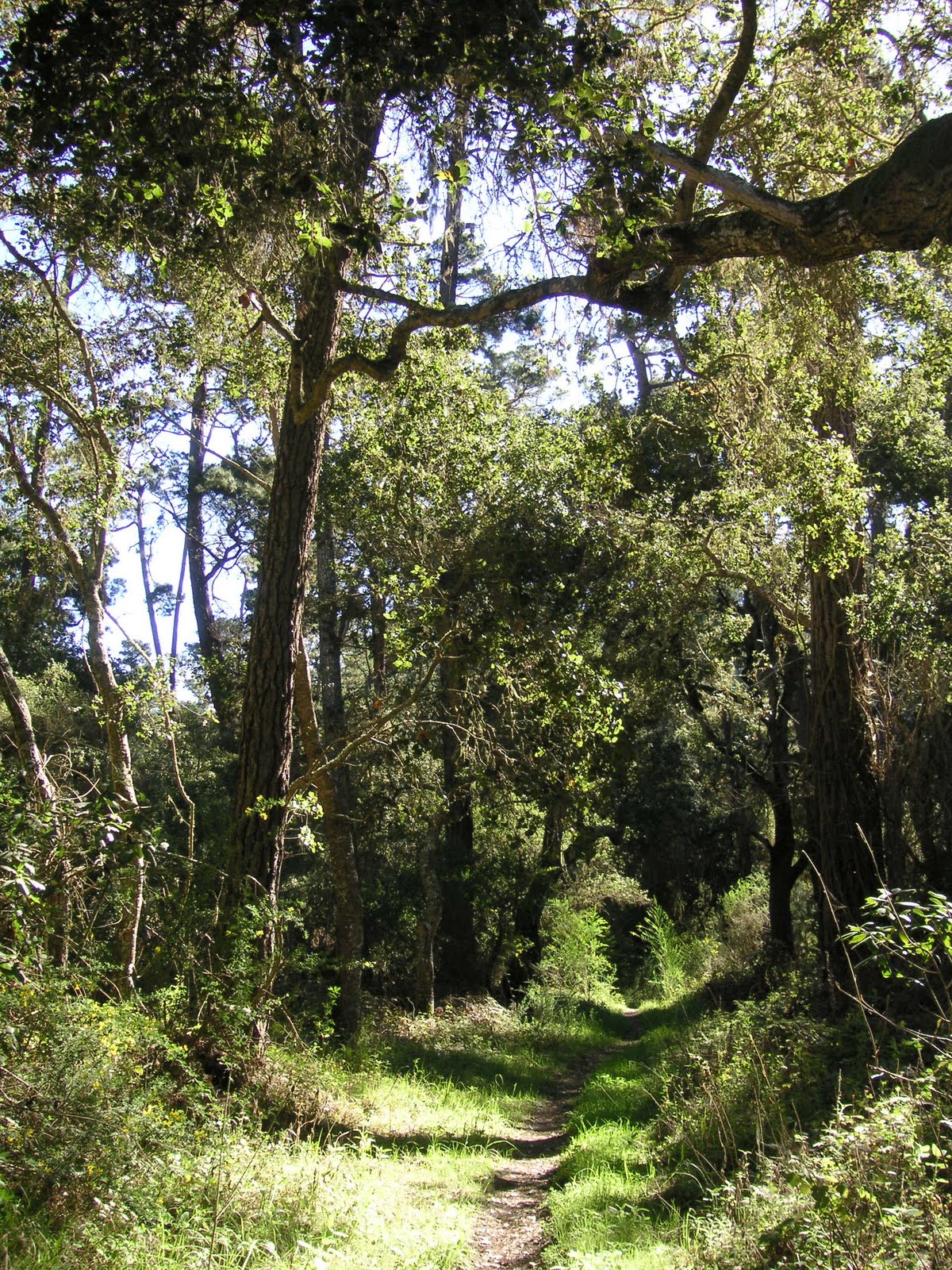
For the record, I'm not sure if this County Park was officially open on Christmas Day, but we took one of several little-known trails up the hill. It starts off as coast live oak woods then gradually turns into Monterey pine forest as the elevation increases. In a couple spots, freshly fallen trees blocked the old trail. I was impressed with how soft the new trail was around these disturbed areas. It felt very spongy on the feet, as if I were walking underneath redwoods. I've heard this area is called a closed-cone pine forest from a blogger who recently shut down his blog. I wasn't aware of this term before. Despite the lack of fire, it looks like the Monterey pine has no problem reseeding itself. Jacks Peak has one of the few remaining native stands of Monterey pine in the world. We also looked for where the proposed zipline will be placed, which has caused quite a controversy among the prominent older folks in our area. The views are absolutely stunning from the summit of Jacks Peak of both Monterey harbor and "the mouth of the Valley" as us locals refer to it, which is really the east side of Carmel and whose main claim to fame is Clint Eastwood was once mayor. The zipline would be thrilling and perhaps a nice tourist attraction. However, I can't say I'd fork out $100 for the experience, especially since I live here.

wavyleaf soap plant ~ 12/25/11 ~ Jacks Peak

wavyleaf soap plant
Chlorogalum pomeridianum var. pomeridianum
Asparagaceae (formerly Agavaceae, Hyacinthaceae, & Liliaceae)

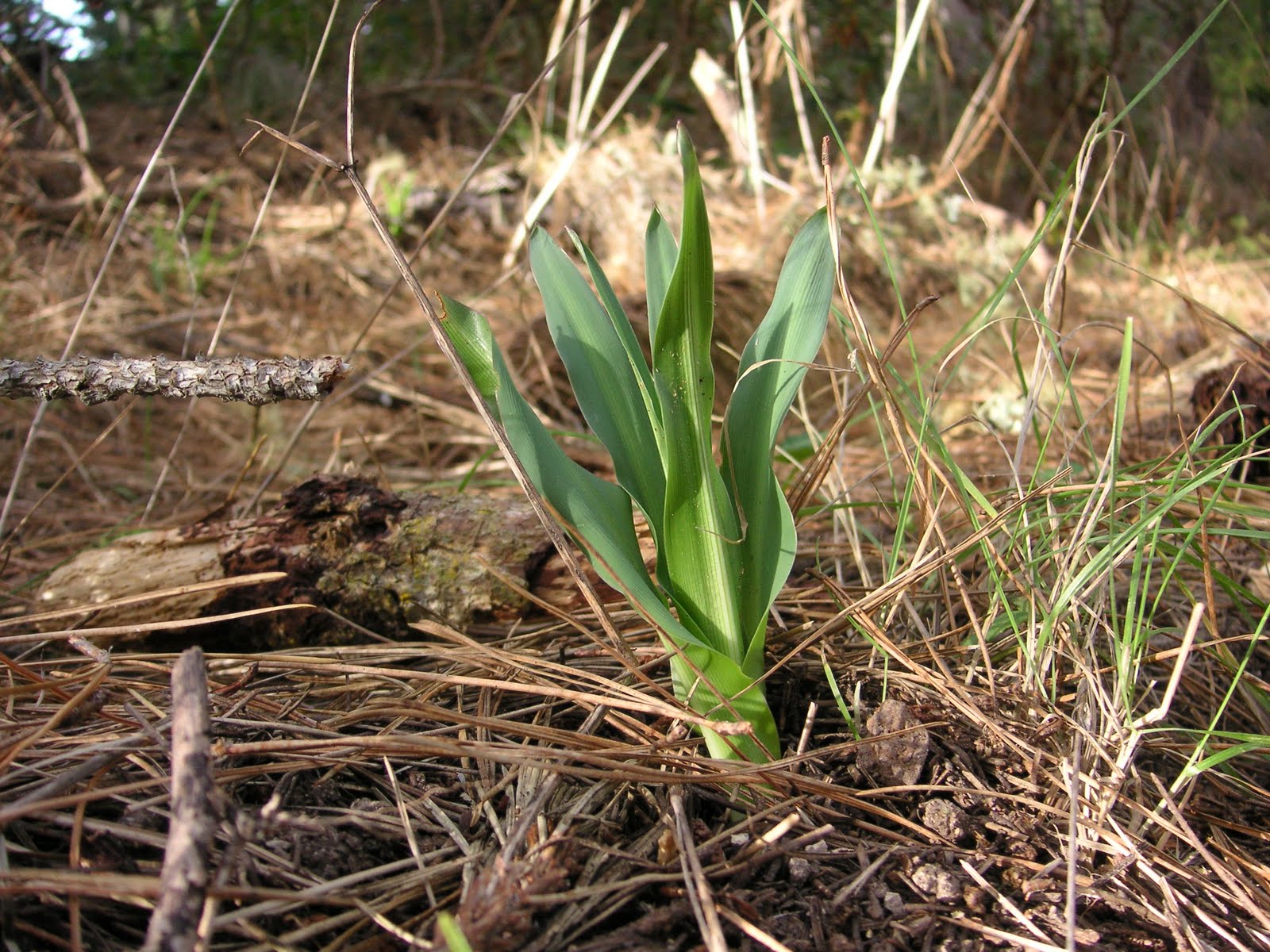
Edited 01/03/12 - I originally posted this as a sprout of Fremont's star-lily, but thanks to my commenters, I've corrected the ID above. It's been a goal of mine to track the seasonal evidence of both death camas, aka Fremont's star-lily, and soap plant, especially in areas where they literally grow from the same spot of ground like at Jacks Peak. I've made a fuss about how several online sites have them mixed up, and I've admitted I get them confused, too, when they only have green leaves - the flowers are too distinctive to ever get them mixed up. I've now concluded that death camas is an early flowerer compared to 3-4 months later in the season soap plant.

Monterey pine and coast live oak ~ 12/25/11 ~ Jacks Peak


coast live oak
Quercus agrifolia var. agrifolia
Fagaceae

This post is for Cindy of Dipper Ranch based on her recent comment. I wish I had better pictures of how the ends look chewed. I noticed before at Jacks Peak that tips of Monterey Pine litter the trail. This is the first time I noticed tips of coast live oak also on the trail. To me they look like they've been chewed off, but I don't really know. We haven't had any wind storms lately, so I don't think that's the reason. It just seems a bit unusual to find tips of trees on the forest floor. Maybe a pruning-happy tree squirrel did this? Anyone have any ideas as to why this happens?

Thursday, August 4, 2011

wavyleaf soap plant ~ 08/04/11 ~ Jacks Peak


posted 01/03/12 - This is the exact area I photographed death camas back on February 11, 2011. When I took these pictures, especially the middle one above, I truly believed I had finally captured both soap plant and death camas together. Now that I've had the space of time to look at the pictures, all the fallen leaves look like wavyleaf soap plant.

Friday, February 11, 2011

habitat ~ 02/11/11 ~ Jacks Peak County Park

Jacks Peak County Park
February 11, 2011

posted 02/19/11 - I think this will be the last post for this hike at Jacks Peak. I have more photos but nothing extraordinary to share. It's Andy's favorite destination to trail run from home. Yep, he regularly runs 7-15 miles several times a week; I don't usually run... I prefer to do other things. It's great in that he finds hidden, non-mapped trails and then shows me. I prefer parking on one of the lower roads like Aguajito and then hiking up. Jacks is the highest peak on the Monterey Peninsula. Truth be told, most of the ID pictures shown below are from outside of the park boundaries. We're still not sure who owns the land that we use and appreciate so much. The trails to the park are often used by horse riders. The park itself is a classic county park with running water, bathroom facilities, big fields of lawn, bbqs, and picnic tables. The trails within the park are fairly flat and some have incredible views of both sides of the peninsula. Even after almost 8 years of living here, I still get turned around on the peninsula. Based on older pics of the Bay, this looks like it's above and to the west of Huckleberry Hill, consisting of the same Monterey pine forest.

Monterey pine ~ 02/11/11 ~ Jacks Peak

male cones with pollen

old female cones

pine trunks in native habitat

Monterey pine
Pinus radiata
CNPS 8th Edition Inventory
for more information click here and here
Pinaceae

posted 02/19/11 - If you click on the first photo to enlarge it, you may be able to see the yellow pollen borne on the air to the right of the pic (no, that speckly stuff isn't due to my poor photography skills). During the last week of January, we noticed the thick annual pollen dusting on many parked cars - I wonder if there's some kind of electrostatic charge that particularly attracts pollen to the metal and glass of cars. There are many species of trees in the area, so I don't know if I can blame the Monterey pines for our non-stop runny noses. The recent rains do seem to help alleviate the allergies.

While the Monterey pine tree has been introduced around the world for lumber, apparently, the Monterey Peninsula is one of the few remaining places of native forests; it's actually considered a rare and endangered plant in California. I do find it interesting how the shape of the tree changes as it ages, from a traditional triangular Christmas tree shape when it's younger to a tall, rounded top shape once they mature.

dwarf mistletoe on Monterey pine ~ 02/11/11 ~ Jacks Peak


western dwarf mistletoe on Monterey pine
Arceuthobium campylopodum on Pinus radiata
CNPS 8th Edition Inventory
Santalaceae (formerly Viscaceae) and Pinaceae

When I saw this I thought it was some kind of insect gall based on the swollen twig area. I figured once I got home, I'd easily be able to search Monterey pine galls and get my answer. However before I even got around to doing that and while I was looking up other plants for Jacks Peak, I noticed a picture that looked very similar to what I saw here. It's a mistletoe! Who knew mistletoes also created gall structures? See and learn something new every day, if I just bother to look.

woodland strawberry ~ 02/11/11 ~ Jacks Peak


I never noticed the proliferation of strawberries at Jacks Peak before. It helps that these bright white flowers caught my eyes. I certainly have never seen the fruit there. I don't know if they get eaten by animals, collected by humans considering it's a popular public park, or rarely produce fruit since it's so shady.

As I was looking for more information, just to learn something new since I've never bothered to look up strawberries before, I was surprised to find there's a second Calflora site out there. The one I use most often, highly recommend, and link to in most of my plant scientific names is Calflora.org. The second one is Calflora.net, which is the personal site of Michael L. Charter and is based out of Southern California. Other than being a little irritated at the similarity of names, (don't know which came first as they both started in 2005), I'm highly impressed by Michael's elaborate website. Can you imagine the time it took him to create that sucker?!?

So, this got me wondering this morning (posted 02/17/11)... what the heck am I doing with this blog? And, why? It started out innocent enough as a casual "I want to learn about the things I see on my hikes." Now, first thing almost every morning (well, after a bathroom visit and a huge cup of tea), while my husband gets his beauty rest, I quietly work on Nature ID. Plus, with any free pockets of time, I'll update or add more posts, many of them backdated far enough that most followers won't even see them. I'll admit to being a bit obsessive. I'm already at 413 labels and 583 posts and I have yet to reach my 2 year blog anniversary (in May). The label lists along the right side of this blog are becoming unwieldy and extraordinarily lengthy (all that scrolling is probably why my wireless mouse eats through so many batteries). At a certain point, I imagine Google's Blogger will complain with site crashes or start charging for hosting. I don't know where this is going or how I want my blog to be in another year. I watch as several other bloggers stop adding new posts or close their accounts entirely and I suspect they simply got burned out - I still really miss Steve Wilson's Blue Jay Barrens blog. However, I do know what I do not want. I do not want to sell anything and am very proud that this is an ad-free blog. And, I do not want to "network" or show off my abysmal nature knowledge - in other words, there's something really freeing in not being the expert and being totally comfortable in saying, "I don't know." I'm relatively anti-social, hence why I like hiking to get away from people and into nature. I'm not on facebook anymore and generally refuse to join nature groups, clubs, and societies. Although, I have met some very nice people online with similar interests. My questions about the future of Nature ID remain unanswered for now.

With that said, I'd love to hear from fellow bloggers on why you blog.
western cauliflower mushroom
Sparassis radicata

Did a quick search this morning and can't find anything that quite looks like this. I'll keep searching. It looks like an airy toasted pastry. Can you ID?

ps - I posted this earlier today (02/16/11) as an unknown meringue-pie-looking fungus. Indeed, it was about the size of a pie, too. Thanks to Jim Johnson's comment below, I was able to track down the ID. Interesting to note, MushroomExpert (linked in the common names) states this is a different species from the eastern cauliflower mushrooms (S. crispa and S. spathulata), which are supposedly primarily found under hardwoods, whereas our true western version is found under pines, as evidenced in my picture. The toasty look in the pic above simply means it's an older fruiting body. Like pie and cauliflower this is an edible mushroom... I think I'm hungry.

broad-leaved lupine
Lupinus latifolius
Fabaceae

Lately, I've been relying heavily on Calflora's What Grows Here search query to help me identify plants, which I would usually have a difficult time figuring out and sometimes spend a couple days agonizing over correct IDs. This is a fairly big lupine and I picked the only perennial lupine on the list. And, it looks correct!
dark-eyed junco / Oregon junco
Junco hyemalis

Well, at least I'm still trying to get photos of birds. These pics aren't too bad for me. I have a better pic of a dark-eyed junco here from last April. It's only because I previously looked up this bird that I even knew what these were on the spot. I had fun watching a group of them as they chased each other from ground to low hanging tree limbs; it was almost as if they were playing tag.

Fremont's star-lily ~ 02/11/11 ~ Jacks Peak

Toxicoscordion fremontii (formerly Zigadenus fremontii)
Melanthiaceae (formerly Liliaceae)

This plant is also known as death camas due to its toxicity to people and animals. Wayne's Word (1/2 way down the link) has the best description I've found describing this with history and references.

As an aside, does anyone else have difficulty taking decent photographs on a sunny day in shaded woods?

There've been major revisions on how to classify this plant in the last decade or so. It's thanks to a couple other bloggers that I even heard of the new names. It used to be in the lily family and has now been separated out to the false hellebore family. Plus, it used to be included in the Zigadenus genus, which is still most commonly used online and is the name in all of my wildflower books. For a nice series of linked pages that explains this at the Pacific Bulb Society, click on the family name above in the ID. I'm updating my previous star-lily posts.

ps 01/05/12 - I moved a 4th picture to a new ID of soap plant.
banana slug
Ariolimax sp.

This is the first non-yellow banana slug I've seen in California. Additionally, it's the first time I've seen a California one not under redwood trees. This pic was taken at Jacks Peak, which is dominated by Monterey pines and oaks, as evidenced by the leaf litter in the pic above. Interesting to note, I've seen this darker version while hiking in Alaska, Washington, and Oregon (but didn't know what they were at the time), also not under redwood trees. I wonder if the habitat has anything to do with the coloring of the slug. We tried to take a picture with my hand next to it, but our camera battery died after the first flash. Based on the size of my hand, I would say this individual was slightly more than 6 inches in length. I'm still searching for a source that can describe the visible difference between the 3 Ariolimax species.

ps - Had I remembered it was Valentine's Day when I posted this morning (02/14/11), I probably would have picked something more romantic... not that I'm much of a softy, ever.
California buttercup
Ranunculus californicus
Ranunculaceae

The first buttercups I've seen this year. It's a cheery little flower. There is a tiny Diptera in the second picture, and you've got me if you can ID it.

wavyleaf soap plant ~ 02/11/11 ~ Jacks Peak


posted 01/05/12 - Once again, thanks to Nature of a Man blogger randomtruth based on his comment, I moved the above photo from my original death camas post.

If you look closely at this picture you can see evidence of browsing (all my newer Nature ID pics can be clicked on for a larger and zoomed photo view).