Showing posts with label x: Pacific Grove Shoreline Park. Show all posts

Monday, September 15, 2014

humpback whale ~ 09/15/14 ~ Pacific Grove Shoreline Park


We've had an extraordinary showing of humpback whales in the Monterey Bay recently, and today was the best so far!  The Monterey Bay Whale Watch states 70 humpbacks were spotted in the a.m., with 79 midday, and 84 (a heck of a lot!) on a bonus evening tour (as is shown here with that whale watching boat that got way too close).  Most of the road (Oceanview to Sunset) along PG's Shoreline Park was unusually crowded with landlubbers and several seriously ginormous camera lenses that likely cost more than my car, all pointing towards the water.  It was a great show.  Without binoculars, we could easily spot 4 very active areas (lots of blows) that didn't seem to move much.  Usually, the activity drifts or disappears after a few minutes.  This apparently lasted for hours.  Very cool.

Kinda crazy, and just goes to show how ignorant I can be sometimes, but humpback whales are still listed as federally endangered.  Ya.  No kidding.  That surprised me.  They were delisted from IUCN's Vulnerable status to Least Concern in 2008.

Here are extra humpback whale links: SIMoN Special Status Species, Marine Species Identification Portal, Marine Bio, Society for Marine Mammalogy, and Wild Whales (out of British Columbia).

I should mention that there were also 200 long-beaked common dolphins (Delphinus capensis), with 1500 seen 2 days ago, September 13, 2014.  Amazing.

Sunday, October 2, 2011

habitat ~ 10/02/11 ~ Pacific Grove Shoreline Park


I often take for granted how beautiful it is here in town. This is pretty much the views we get while driving home from the grocery store, although this day we were walking and exploring. On one side is the Pacific Ocean and on the other is Point Pinos Lighthouse and the Pacific Grove Golf Links with Crespi Pond.

Shoreline Park is a designation that the City of Pacific Grove calls public access coastal areas not otherwise designated as city parks. For the purposes of this blog and location labels, I consider all the unpaved path around the peninsula as Pacific Grove Shoreline Park, starting from Lover's Point (not Hopkins Marine Station) and ending where Asilomar State Beach begins. Ocean View Blvd. transitions to Sunset Dr. next to this unpaved path. I've called this the "poor man's 17-Mile Drive" previously on my blog. It's usually a great place to explore tide pools.

seaside daisy ~ 10/02/11 ~ Shoreline Park

seaside daisy
Erigeron glaucus
Asteraceae

It sure is nice to have an ID that I don't have to extensively search. I'm a little surprised this is my first post of this common coastal flower. Interesting to note, my Introduction to California Spring Wildflowers of the Foothills, Valleys, and Coast book states the seaside daisy "flowers from April to August." That's true. However, I also have a habitat post that shows it blooms as early as February, and here's evidence it blooms as late as October. That's a significant difference in timing of blooms.

As part of my Nature ID blog, I'm attempting to document when plants actually flower around here and not simply repeat others' claims, which may not be entirely accurate. This is the reason why I am so particular about posting to the date of my photos.

red seaweed ~ 10/02/11 ~ Shoreline Park

red seaweed / red algae
Rhodophyta


Last year, during the period of time from the autumnal equinox through October, I captured brown algae (kelp) at Asilomar State Beach and green algae (sea lettuce) at the Monterey Municipal Beach. Without prior intention, I am completing my algae collection with red, even though not all red algae is actually the color red. Just like last year, I again heard the waves starting to crash just before the equinox, which likely break up whatever is growing near the shore. I'm impressed the ocean has seasons just like on land. Like leaves littered on the forests floors, the beaches are littered with seaweed during autumn.

As much as I wanted to place an ID, if only to genus, on this red seaweed, any guess I make would be pure speculation. I even had questions as to how the red seaweed I see on the beach is related to the harmless "red tide" algae. There are macroalgae and microalgae. Lost in the Landscape has an interesting blog post about red tide causing bioluminescent waves. It's all a bit confusing to me, and I've got a lot to learn.

The larger much more impressive giant kelp seems to get all the algae attention around these parts, and information on red algae is difficult to find. The best local sites I've found that picture red algae are:
Stanford's SeaNet Rocky Shore Red Seaweeds
Stanford's SeaNet Subtidal Red Seaweeds
MBARI's Monterey Bay Flora Rhodophyta
CSU Sonoma's Marine Algae of Northern California

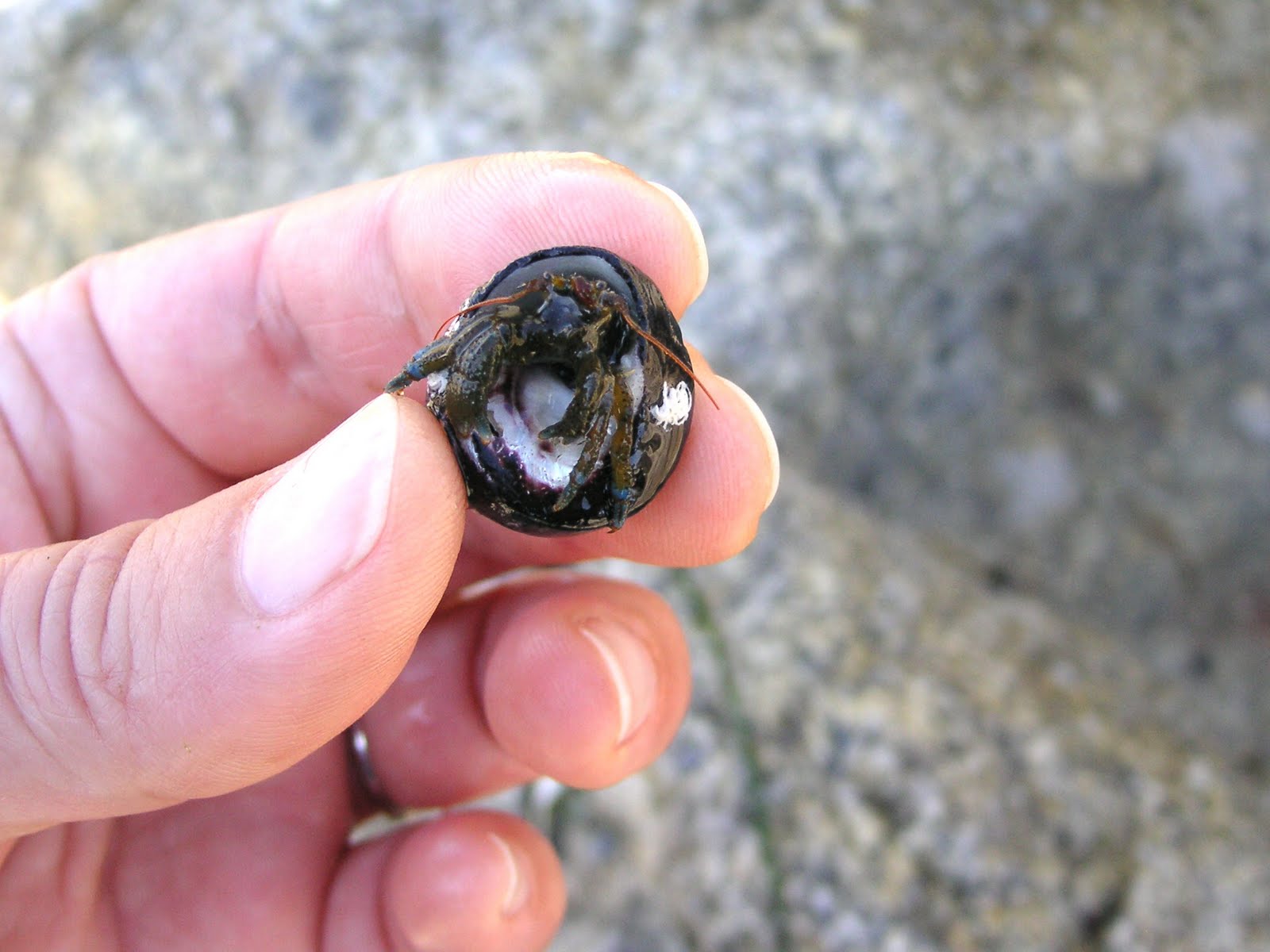
blueband hermit crab ~ 10/02/11 ~ Shoreline Park

Pagurus samuelis

This is the first time I've really looked up hermit crabs. It's a challenge to find local hermit crab information, because most searches show pet hermit crabs from the Caribbean and Ecuador. I've collected better marine internet sources since my first hermit crab post on 06/04/09.

The blue bands on the legs, solid red antennae, location, and behavior make me fairly confident of this ID. We have a variety of hermit crabs here, including grainyhand hermit crab (Pagurus granosimanus), bering hermit crab (Pagurus beringanus), and hairy hermit crab (Pagurus hirsutiusculus).

Thanks to a nifty new interpretive sign, I learned the black shells with sanded tops and edges were made by black turban snails (Chlorosroma funebralis). There are a couple different snail shells being used by hermit crabs in the last picture. My wild guesses are possible Littorna sp. or Nucella sp. Stanford's SeaNet also has a nice representation of other subtidal shelled gastropods. And, I really like Gary McDonald's UC Santa Cruz's Intertidal Invertebrates of the Monterey Bay Area, CA site.

Make sure to click on any of the highlighted words (embedded links) for more information.

black-bellied plover ~ 10/02/11 ~ Shoreline Park


edited 10/10/11 - I originally posted this as best guess winter plumage western sandpiper (Calidris mauri). However, the larger size and short bill kept bothering me. So, on second thought, I think my last-minute guess was correct and have changed the ID for this post. The belly sure isn't black. For a nice picture of dark axillaries that Neil mentions in his comment, check out Carolina Bird Club. Of course, with the bright sunlight and my poor photographs, it could easily have been a shadow. What confirms the ID for me is the white, patterned-dipped tail tip shown in the second pic. I'm keeping the original post below so I can have notes for the future. I am not going to be a decent birder anytime soon. If anyone believes my ID is something else, please, please comment!

posted 10/09/11 - Shouldn't sandpipers be, you know, found on the sand? These sandpipers were much bigger than I think they should be. In fact, when I first spotted them from a distance I was thinking, "Oh good, a new species of gull for my blog." Ha! Nope. Good golly, Calidris and their relatives are so difficult to distinguish, especially with varying plumage depending on the age and season. Don Roberson lists 16 species of Calidris here in Monterey County. He also has quite a discussion of how western sandpipers are often mistaken for semipalmated sandpipers (Calidris pusilla), which was another possibility I was considering since it has a shorter bill.

ps - Argh! Maybe it's a winter plumage black-bellied plover (Pluvialis squatarola)? That would certainly explain the larger size.

Pacific silverweed ~ 10/02/11 ~ Shoreline Park


This plant reminded me much of a yellow-flowered woodland strawberry and with the fruit somewhat similar to that of a blackberry (click the second picture to better see the berries).

You'll notice above I have an aka, also known as. I check multiple sources before I decide if it should be aka or formerly. (Haha! Prince's "Purple Rain" just popped into my head. Should he've been the artist fka Prince? Sounds bad.) I've refrained from using the botany standard syn. for synonym, because often sources simply don't agree. Indeed, Jepson even suggests Potentilla egedii var. grandis as a synonym. Aka feels more appropriate if anyone wants to do an internet search under any of the names I provide.

Saturday, February 5, 2011

torch aloe ~ 02/05/11 ~ Shoreline Park

torch aloe / krantz aloe
Aloe arborescens
Asphodelaceae (now included under Xanthorrhoeaceae)

I'm still not positive about this ID. Calflora essentially ignores this genus with two species poorly represented. I've searched, but it doesn't seem anyone really knows which particular species is so prolific along the seashore in Pacific Grove and massive - I was standing straight up when taking this photo. Does anyone know for certain? It originates from southern Africa.

ps 01/12/12 - I often find visitors get much better pictures than I could ever make, because I am someone who sees this kind of thing every day and after a while I don't appreciate the beauty: http://www.faroutflora.com/2012/01/12/fiery-aloe-spikes/
great egret
Ardea alba

Often great egrets look much like snowy egrets (Egretta thula), especially from a distance and in photographs when the sense of size is misleading. For a really nice little table on how to tell the two birds apart and additional photos from this same area of what I prefer to call Pacific Grove Shoreline Park, check out Bread on the Water.

Wednesday, December 15, 2010

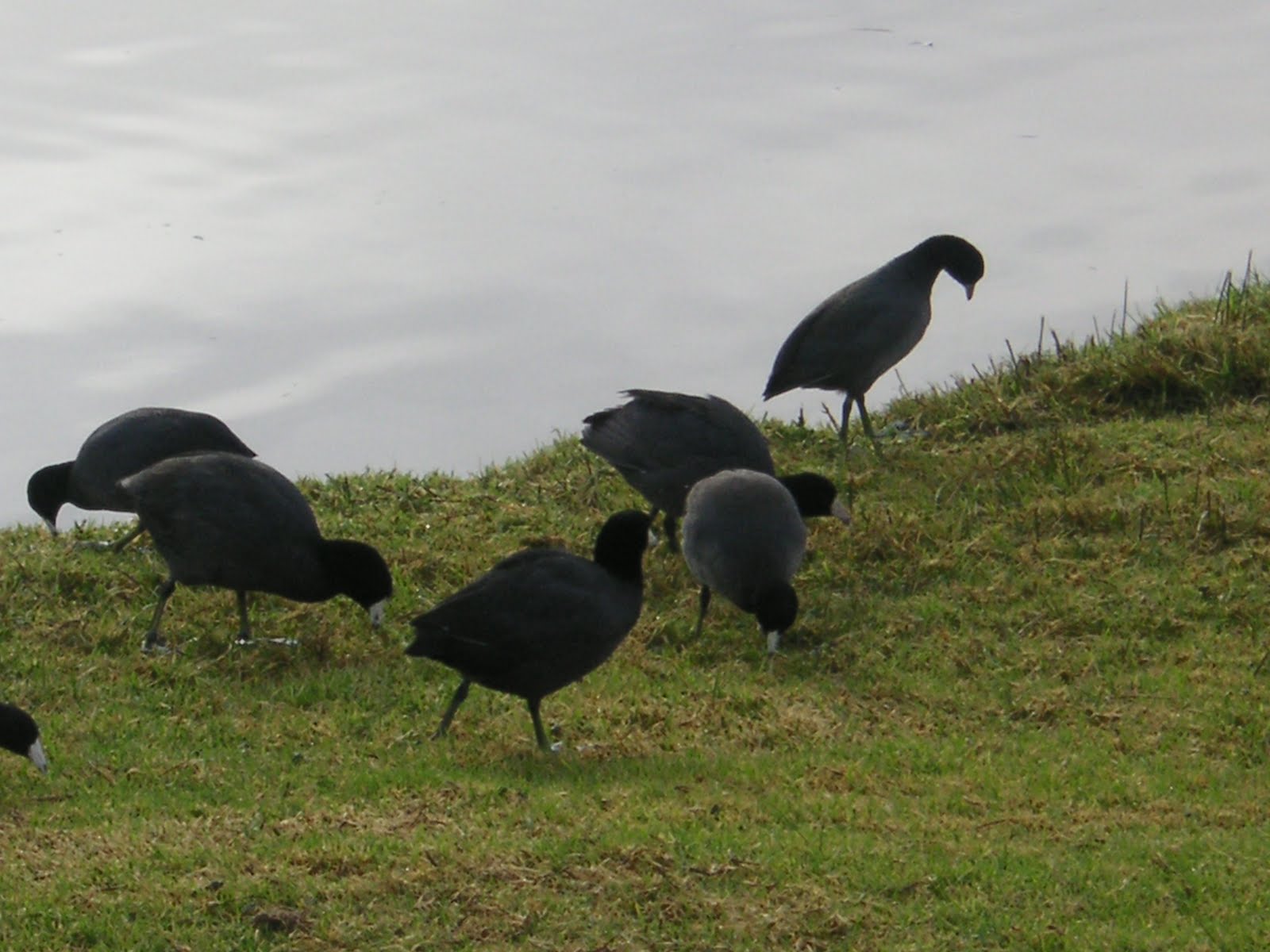
American coot ~ 12/15/10 ~ Crespi Pond


American coot
Fulica americana

For all our futile searching for the wacky looking baby coots this past spring and summer, we not once spotted even an adult coot. They must nest elsewhere, despite numerous websites and books stating they're here year-round. I wish I had logged when we started seeing the adults in our area again; I think it might have been October, but I can't be sure of my memory now. In any case, we're now spotting numerous coots everywhere, from Crespi Pond along Shoreline Park as shown above, to El Estero, to Moss Landing and Elkhorn Slough. They're funny looking birds.

ps 10/02/11 - We saw our first coot of the season at Crespi Pond today. There was only one. I'm sure more will come. I still don't know where they nest. I really want to see a baby coot in person some day.

Tuesday, September 28, 2010


great blue heron
Ardea herodias

Finally! I had the camera on me while driving by Crespi Pond in the Pacific Grove Golf Links near Point Pinos Lighthouse. We regularly spot great blue herons and black-crowned night herons here (not to mention American coots and a plethora of various gulls), but we rarely have the motivation or camera to stop and watch. In fact, there are two night herons hiding in the reeds in the second pic (for lack of a better ID of this pond plant), barely evidenced by their white faces. It's our standard route home from the grocery store; I know, what a terrible commute (psht!). As for the location, this is right across the street where Oceanview Blvd. changes into Sunset Dr., so I am including it in the Pacific Grove Shoreline Park location label.

I don't have much commentary on the great blue heron. I know there have been massive annual nests that have been killing the tops of the pines near a friend's house in Monterey and where they hunt for gophers in her yard. Usually, when I see great blues, nights, or great egrets, I'm out for my morning walk near the Coast Guard Pier... without a camera.

ps 03/15/11 - For great pictures of a great blue heron catching a gopher, check out John Wall's Natural California here and here.

Sunday, July 25, 2010

salt heliotrope ~ 07/25/10 ~ Shoreline Park


salt heliotrope
Heliotropium curassavicum
Boraginaceae

I didn't believe our new orchid friend, but he was correct and this belongs to the borage family along with fiddlenecks and forget-me-nots. This heliotrope has several common names, including seaside heliotrope, quail plant, and Chinese pusley. I think the Chinese parsley was misread somewhere and is now also considered a common name.

Tuesday, March 2, 2010

sunset in Pacific Grove
March 2, 2010

It's been a rough several months for us, so it's nice to stop and reflect on what has passed and look forward to tomorrow.

ps - If anyone wants to hear my opinion of home infusion therapy, vancomycin, or ertapenem, please contact me through comments.

Saturday, February 13, 2010

habitat ~ 02/13/10 ~ Pacific Grove Shoreline Park

Pacific Grove Shoreline Park
February 13, 2010

It's difficult to capture a sense of scale in photos without an obvious reference such as a person or a hand. We had unusually humongous waves this past week (especially considering there hasn't been a storm system in our area for over a week) and it was incredibly noisy at night. In fact, a tourist drowned at nearby Carmel Beach today (which incidentally makes me think twice about volunteering this coming season for grunion greeting... at night with no lights, at high tide, at Carmel Beach with strong rip currents... hmm?). Also, further north at the infamous Maverick Surf Contest in Half Moon Bay, several spectators were severely injured by rogue waves. Gotta have a healthy respect for Mother Nature!

Wednesday, January 20, 2010

habitat ~ 01/20/10 ~ Pacific Grove Shoreline Park


Pacific Grove Shoreline Park
January 20, 2010

It felt very stormy. The gulls were all aflutter with the crashing waves and took shelter on the pond near the lighthouse. I couldn't believe there were fellas surfing in this!

Thursday, June 4, 2009

hermit crab ~ 06/04/09 ~ Shoreline Park

hermit crab

While exploring the tide pools along Oceanview here in town, we played with the hermit crabs. This one popped out of its shell and mooned me. He quickly slipped right back into his shell when I dropped him back into the water. We pried small limpets off the rocks and instigated food fight frenzies amongst the hermit crabs. It was great fun!

Saturday, April 4, 2009

Sunday, February 8, 2009

torch aloe ~ 02/08/09 ~ Shoreline Park

torch aloe / krantz aloe
Aloe arborescens
Asphodelaceae (now included under Xanthorrhoeaceae)

This is a common plant along the PG rec trail. A group of volunteers are working on removing these massive plants. The flower looks superficially like a torch lily, but this is a succulent (Aloe genus).

ps 01/18/10 - These have been blooming along the rec trail at least since December.

pss 02/05/11 - I originally posted this as NOT red hot poker. For a much better picture, check out my latest post.