Tuesday, March 22, 2011

large yellow underwing ~ 03/22/11 ~ at home


large yellow underwing moth pupa
Noctua pronuba

While I was turning one of my compost bins last week (posted 03/27/11, pics taken 03/22/11), lo and behold I found a little surprise. And, no, it is not a turd. Good thing I didn't slice it with my trowel! Considering I released several dozen caterpillars in this compost bin last fall, I'm fairly sure this is a painted tiger moth pupa. I know, I know, I said I wasn't going to disturb this bin until October or November of 2011. However, the prolific weed of hairy bittercress set seed a month ago in this bin, and I pulled them all out. The pupa measures about 26mm in length and wiggled furiously when I laid a cold plastic ruler next to it. I've since placed the pupa in its own container with soil and pantyhose on top to await to see what emerges. I'm keeping the container outside so as not to falsely speed up the development of this pupa with the warmth of our home. The timing of my observations so far does not match the literature, e.g., W.E. Conner's Tiger Moths and Woolly Bears.

For those new to my blog, here's a timeline of past tiger moth posts with embedded links:
October 17, 2010 - found an adult female laying eggs next to our front door
October 26, 2010 - eggs hatched and I collected the caterpillars
November 6, 2010 - released 2nd instar caterpillars in compost bin

Here are couple things to note: 1) I frequently call caterpillars "cats." Even though I've loved up to 3 kitty cats at one time, usually I'm referencing the insect. 2) I'm actually raising several different Lepidoptera on my balcony right now.

ps 05/25/11 - I posted this originally as a painted tiger moth pupa and now that it emerged on 05/13/11, I have corrected the ID above. To read the new post on this large yellow underwing moth, click here.

Sunday, March 20, 2011

habitat ~ 03/20/11 ~ Fort Ord - BLM InterGarrison

Fort Ord Public Lands - InterGarrison entrance
March 20, 2011

Considering it had been raining for a solid week before this hike, and indeed during our hike, all the vernal pools we passed were filled. They look like lakes, but most of them do dry up by the end of summer. Many rare plants can be found around the vernal pools, including Hickman's popcorn flower, which we found completely submerged by the recent rains.


This is quite possibly the largest vernal pool at Fort Ord. It extends to about twice as wide as shown in the picture. The InterGarrison parking area, consisting of a sand lot with no facilities, is located straight as the crow flies to the left of the water tower and a bit beyond.


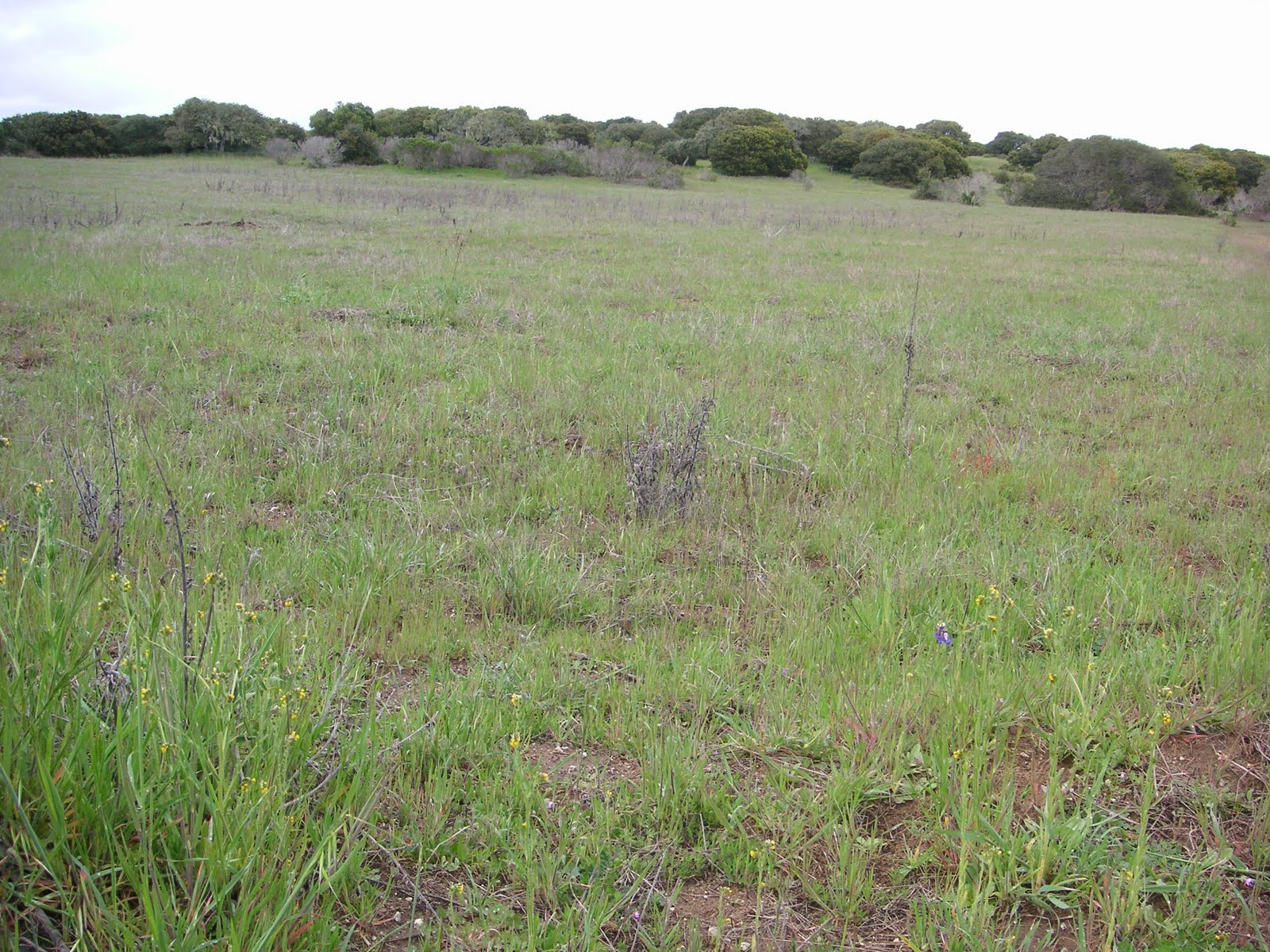
I took this photo to show how this particular meadow looks before the sky lupine really gets going. There is only one lone lupine blooming now with some fiddlenecks. For a comparison photo taken from almost the exact same spot, see my May 8, 2010 lupine post.


This photo is looking southeast over towards the Creekside entrance where the trails are a bit more established and erm, less dangerous...


And the last photo is a reminder that the BLM lands were once an Army training site. I didn't get a great shot of the sign, because I was more interested in the brush clearing they were doing of a trail that had been previously open. The sign says, "Danger. Do not enter. This area is being investigated for ordinance and explosives." I got on my soapbox and mentioned this in my star tulip post from this hike.

While I don't particularly like hiking in the rain, Andy convinced me to get out there with hopes to see the bobcat he spotted the day before during a trail run. We only saw some bobcat poop in the usual places. I have to say, I think Fort Ord is becoming my favorite local place to hike, even more than Garland Ranch Regional Park.

ps 05/12/12 - At the end of April, I was contacted by a California Stare University, San Jose student who is working on a group project regarding California coastal wetlands. Apparently, Fort Ord vernal pools was his assignment for a presentation. Since his photos from a March 8 personal tour were of very dry vernal pool areas, he used and credited my first 2 pictures above to show vernal pools at Fort Ord with actual water in them. It pleases me that students and university professors are finding my blog for first-hand accounts, which are not simply repeated blurbs found on so many sites.

blue dick ~ 03/20/11 ~ Fort Ord

blue dick
Dichelostemma capitatum ssp. capitatum
Themidaceae (aka Asparagaceae and formerly Liliaceae)

It always amazes me how one or two colors of wildflowers seem to dominate at a time. During this particular hike at Fort Ord, lilacs (blue dicks, ceanothus, fiesta flowers, star tulips, yerba santas) and bright yellows (buttercups, footsteps of spring, oak catkins, sun cups) were everywhere. It's as if Mother Nature only had two tubes of flower paint and also consulted a color wheel.

CA yerba santa ~ 03/20/11 ~ Fort Ord


California yerba santa
Eriodictyon californicum
Boraginaceae (formerly Hydrophyllaceae)

I've hiked past these always wondering what they are, most notably for the black fungus covering most of the leaves. You can see some black leaves in both pictures above. Wikipedia says this fungus is called Heterosporium californicum, but I can't find any online information other than this sooty fungus is common on this plant. This is the first time I've seen these shrubs blooming. It's really hard for me to believe that these are in the same Eriodictyon genus as the woolly yerba santa I spotted at Pinnacles recently. Erg. Once again this plant has changed families from the waterleaf family Hydrophyllaceae to the borage family. These family changes are harder to track than women who change their surnames due to marriage and/or divorce.